What matters most
- Provide model, drawing, revision, critical dimensions and the mating context.
- Classify each face and the defect and finish standards.
- State annual volume, program life and launch timing.
Send the data that drives tool price and risk
Evaluate the technical choice together with part requirements, tooling consequences, production controls, and the evidence required for approval.
Geometry
Provide model, drawing, revision, critical dimensions and the mating context.
Surface
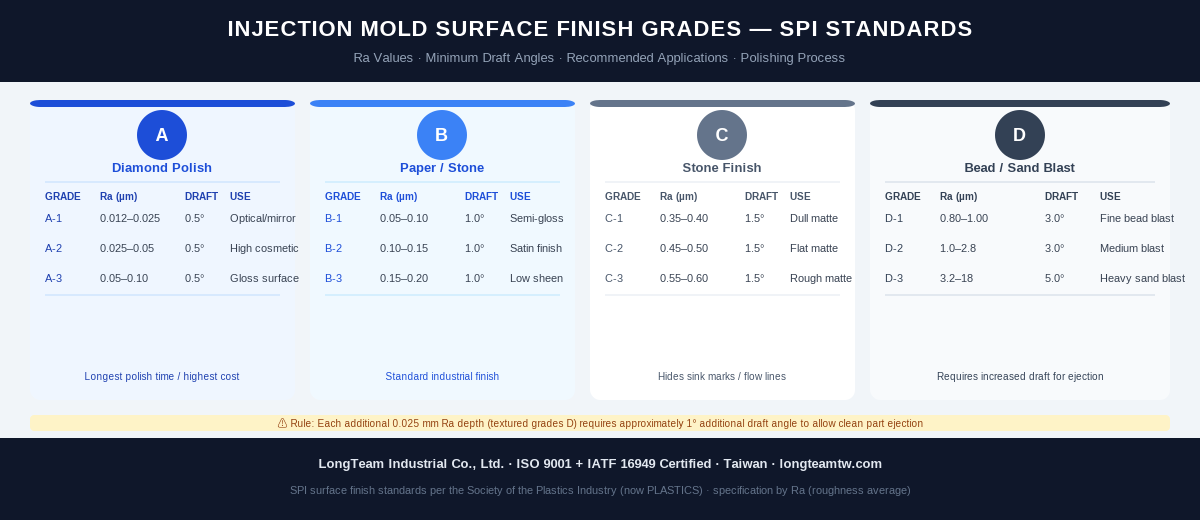
Classify each face and the defect and finish standards.
Volume
State annual volume, program life and launch timing.
Approval
State the approval standard and inspection expectations.
Technical guide
The sections below retain the detailed design, tooling, process, and quality context needed to evaluate this topic beyond the summary.
A quote for a lamp tool is only as good as the data behind it. When surfaces, materials or volumes are missing, the molder prices the risk. This checklist lists what to send so quotes are comparable and fewer rounds of questions are needed. When your package is ready, send your part for engineering review.
Geometry
- 3D model (STEP or native) and a 2D drawing with the revision.
- Critical dimensions and flatness or profile callouts, marked clearly.
- Mating parts or the assembly context, including seals, clips and joint types.
Material and surface
- Resin grade or performance target for each part, and any coating.
- Surface class for each face: polished, textured, functional, and the finish or texture standard.
- Where gate vestige, parting lines and ejector marks are not allowed.
- Color and transparency requirements, including any two-material or two-shot intent.
Volume and program
- Annual volume by part and the planned program life.
- Launch date and any prototype or bridge tooling needs.
- Cavity and tool-life expectations, if known.
Quality and approval
- The approval standard that applies, such as a PPAP level or customer-specific rules; see the PPAP and APQP guide.
- Cosmetic defect standard and limit samples.
- Inspection and gauging expectations for critical dimensions.
What to expect back
A good molder returns questions on surface classes, gate location, two-shot opportunities, and trial plan. Those questions are a sign the quote is being built on the real part rather than on assumptions. Compare quotes on the same inputs; the cost breakdown guide explains where the price differences come from.
Send the package as one set rather than in pieces. A single message with the model, drawing, surface plan and volume range lets the molder review geometry, tooling and cost together, and the questions that come back are then about real risks, not missing files.
A short template to copy
- Part name, revision, model and drawing attached.
- Resin or performance target, color, coating.
- Surface classes by face, with finish or texture standard.
- Second material or two-shot intent, if any.
- Annual volume, program life, launch date.
- Approval standard and sample requirements.
- Mating parts and critical fits.
- Shipping destination and packaging expectations.
Pasting this list into the first message and filling what you know already removes most of the follow-up questions.
Common RFQ gaps on lamp programs
- No surface classes. The molder cannot tell which faces are optical, cosmetic or hidden, so each face is priced at the worst case.
- Unclear second material. A bezel, seal or color section is mentioned in a note but not drawn, so a two-shot route is never evaluated.
- Missing mating parts. Sealing and joint requirements are unknown, so flatness and tolerance are guessed.
- No volume range. Without a volume and life, the steel, cavity count and hot runner choices cannot be justified.
- Approval path not stated. PPAP level, sample counts and inspection requirements change both cost and schedule.
How to compare the quotes you receive
Line up quotes by what they include, not only by the total. Check the steel and hardness, the number of cavities, the type of runner, the polish and texture scope, the trial count included, the sample quantity, the packaging and the lead time to first samples. A lower price that leaves out polish, trials or second-shot tooling will return as change orders. Ask each supplier to state its assumptions about surfaces and volume in writing so the comparison is fair.
If any of these items are not yet known, say so in the RFQ and give a range. A molder can often propose options when the open points are visible, which is better than a quote built on hidden assumptions.
What to confirm before supplier review
Use the drawing, material specification, expected demand, application conditions, and acceptance requirements to turn a general process discussion into a program-specific review.
- Which faces are polished, textured or functional?
- What annual volume and program life apply?
- Which approval standard applies?
- Is a two-material or assembled design under consideration?
Continue the engineering review
Use the related guides and capability pages to connect this topic to part geometry, tooling, molding, and qualification decisions.