What matters most
- Review heat sensitivity, residence time, color changes, regrind policy, and approved processing window.
- Consider gate appearance, balance, pressure, cosmetic risk, and dimensional requirements.
- Compare controller, manifold, nozzle, leak, maintenance, and spare-part implications.
Compare the complete runner system
Evaluate the technical choice together with part requirements, tooling consequences, production controls, and the evidence required for approval.
Material
Review heat sensitivity, residence time, color changes, regrind policy, and approved processing window.
Part
Consider gate appearance, balance, pressure, cosmetic risk, and dimensional requirements.
Tool
Compare controller, manifold, nozzle, leak, maintenance, and spare-part implications.
Economics
Model resin use, cycle, labor, maintenance, tool cost, and expected demand with current inputs.
Technical guide
The sections below retain the detailed design, tooling, process, and quality context needed to evaluate this topic beyond the summary.
Key Takeaways
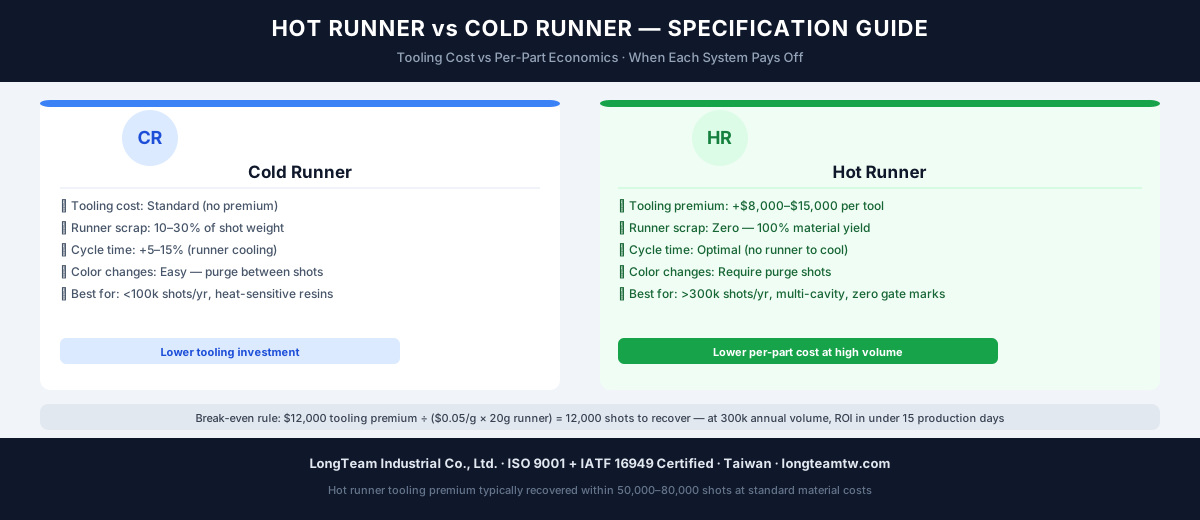
- 1 Hot runner tooling costs 20–50% more than comparable cold runner molds — a 4-drop thermal gate system adds roughly $18,000–$35,000 to tooling cost, while a 16-drop valve gate system can add $45,000–$90,000.
- 2 Hot runners raise material utilization from 60–70% to 95–98% (eliminating runner scrap entirely) and reduce cycle time by 15–40% — savings that compound rapidly at high production volumes.
- 3 The breakeven threshold is typically 100,000–200,000 parts per year: below 50,000 parts/year, hot runner payback rarely justifies the investment; above 200,000 parts/year, ROI often arrives within 3–6 months.
- 4 Gate type matters as much as system type: valve gates leave nearly invisible vestiges for Class A cosmetic parts; thermal (open) gates are simpler and lower-cost but leave a more noticeable mark and are better for non-cosmetic surfaces.
How Each System Works
Every injection mold needs a path to deliver molten resin from the machine nozzle into the part cavity. The runner system is that path — and the choice between hot and cold fundamentally changes the economics and performance of the entire production program.
In a cold runner system, molten resin travels through unheated channels machined into the mold plates. Each cycle, a solidified runner (sprue + runner + gates) is ejected along with the finished part. That runner is either scrapped or reground for potential reuse. The system is mechanically simple, easy to maintain, and well understood by every toolmaker — but it generates material waste and extends cycle time by tying cooling duration to the thickest runner cross-section rather than the part itself.
In a hot runner system, the resin path is maintained at processing temperature throughout the cycle — typically 200–320°C — via an electrically heated manifold and individual heated nozzles, each controlled by a dedicated thermocouple zone. The plastic never solidifies in the runner. Each shot delivers only the part (and gate vestige), with zero runner waste. According to ZetarMold’s hot runner system guide, temperature zone precision holds to ±1–2°C after thermal stabilization — a level of control that directly reduces shot-to-shot weight variation to ≤±0.8% across validated multi-cavity molds.
Hot Runner System Types: Thermal Gate, Sprue Gate, and Valve Gate
Not all hot runner systems are equivalent. The gate type determines gate vestige appearance, shear sensitivity, and tooling complexity. Understanding the three main configurations prevents over-specifying (adding cost unnecessarily) or under-specifying (creating cosmetic problems that require mold rework).
| Gate Type | How It Works | Gate Vestige | Best For | Tooling Premium |
|---|---|---|---|---|
| Thermal (Open/Hot Tip) | No moving parts; gate freezes thermally between shots | Small pip or blush mark | Non-cosmetic surfaces, commodity resins (PP, PE, ABS) | +15–25% vs cold runner |
| Sprue Gate (Direct) | Single open pipe directly to cavity; lowest pressure drop | Larger vestige — typically trimmed | Medium-to-large single-cavity parts; semi-crystalline resins | +15–20% vs cold runner |
| Valve Gate | Mechanical valve pin opens/closes the gate orifice under pneumatic or servo control | Nearly invisible — flush with part surface | Class A cosmetic surfaces, engineering resins, sequential fill, medical | +25–40% vs cold runner |
Valve gates offer an additional process advantage beyond cosmetics: sequential valve gating (SVG) enables independent timing of each cavity’s fill, which eliminates the weld lines and flow hesitation marks that appear when multiple gates open simultaneously. For large automotive exterior panels or appliance bezels with tight Class A requirements, SVG is often the only way to achieve acceptable surface quality without post-mold painting. Per Mold Making Technology’s analysis of valve gate systems, valve gates also reduce molded-in stress versus thermal gates because the pin can open slowly, reducing the initial shear spike as melt enters the cavity.
Cost & Performance: Head-to-Head Comparison
The table below consolidates the key performance and cost differences between cold runner and hot runner systems, drawing on data from ZetarMold and Mold Making Technology.
| Parameter | Cold Runner | Hot Runner |
|---|---|---|
| Tooling cost premium | Baseline | +20–50% over cold runner |
| Temperature controller | Not required | $3,000–$15,000 additional capital |
| Material utilization | 60–70% (runner scrap) | 95–98% (near-zero scrap) |
| Cycle time | Runner cooling governs cycle | 15–40% faster than cold runner |
| Parts per hour (example: 8-cavity) | ~514 parts/hr (28 s cycle, 4-cav) | ~1,440 parts/hr (20 s cycle, 8-cav) |
| Shot-to-shot weight variation | Depends on runner balance | ≤±0.8% (validated molds) |
| Color change / resin change | Fast — purge runner; no residual melt | Slow — full manifold purge required |
| Maintenance | Simple — no heaters or controllers | Nozzle tip replacement every 500k–1M shots; heater cartridge every 2–5 years |
| Breakeven production volume | Best <50,000 parts/year | ROI positive above 100,000–200,000 parts/year |
Decision Framework: When to Specify Each System
The right answer is determined by five variables: annual production volume, resin price, gate cosmetic requirements, number of cavities, and program amortization window. The framework below covers the most common scenarios.
| Scenario | Recommended System | Reasoning |
|---|---|---|
| <50,000 parts/year, standard resin | Cold Runner | Hot runner tooling premium rarely pays back within a 24-month program |
| 50k–200k parts/year | Model-dependent | Run total-cost-of-ownership (TCO) analysis; resin cost >$5/kg tips the balance toward hot runner |
| >200,000 parts/year | Hot Runner | Cycle time reduction and scrap elimination typically recover tooling premium within 3–6 months |
| Engineering resins (PEEK, PC, LCP) at any volume | Hot Runner | Runner scrap of high-cost resin is too expensive to discard; regrind degrades properties |
| Class A cosmetic surface at gate | Valve Gate Hot Runner | Only valve gate delivers a gate vestige flush with the part surface — invisible after mold polish |
| Frequent color or resin changes | Cold Runner | Cold runner purges in one cycle; hot runner manifold requires 10–30 minutes of purging and wasted material |
| Medical or automotive (IATF 16949 / SPC required) | Hot Runner (valve gate preferred) | Zone-controlled temperature uniformity supports Cpk >1.67 on critical dimensions; valve gate minimizes shear-induced degradation |
| Prototype or bridge tooling run | Cold Runner | Simpler construction, faster build time, lower cost for short-run programs ahead of full production tooling |
One practical factor that shifts the decision: whether the runner weight consistently exceeds 8–12% of the part shot weight. Once the sprue and runner mass crosses that threshold — especially when regrind is limited or prohibited by material specification — cold-runner scrap transforms from a manageable variable cost into a significant monthly fixed expense. At LongTeam, every RFQ includes a runner-weight analysis during the initial DFM review; when runner mass exceeds 10% of shot weight for a volume program, we proactively recommend the hot runner investment to the customer before tooling commitment.
LongTeam’s Approach: System Selection Driven by Your Economics
LongTeam Industrial designs and builds both cold runner and hot runner molds. Because we build tooling in-house and manage production under the same roof, our mold engineers carry a specific bias: we recommend the system that optimizes total program cost for the buyer, not the system that is simplest to build for us.
For each runner system inquiry, our engineering team runs a three-step evaluation before recommending a configuration:
- Resin cost analysis — calculating annual runner scrap cost in dollars at projected volume, using the customer’s supplied resin price
- Cycle time delta — comparing cold-runner vs hot-runner cycle based on part geometry, cooling simulation, and runner cross-section analysis
- Tooling TCO comparison — projecting payback period of hot runner premium against combined material savings and cycle-time productivity gain over the program horizon
The output is a written recommendation with specific numbers, presented to the customer before any tooling purchase order is issued. Our IATF 16949-certified quality system then applies the same SPC discipline to hot runner process validation as to any other critical production parameter — ensuring that the temperature control precision the system provides translates to documented Cpk improvement on your critical part dimensions.
Get a Runner System Recommendation Before You Commit to Tooling
Share your part design, annual volume, and resin with LongTeam’s engineering team. We will return a written runner system recommendation — including a payback analysis with your specific numbers — before any tooling commitment is made.
Contact LongTeam →What to confirm before supplier review
Use the drawing, material specification, expected demand, application conditions, and acceptance requirements to turn a general process discussion into a program-specific review.
- Which resin and color-change requirements apply?
- How will cavities be balanced and gates maintained?
- Who supports the runner system and spare parts?
- Which demand assumptions support the investment decision?
Continue the engineering review
Use the related guides and capability pages to connect this topic to part geometry, tooling, molding, and qualification decisions.