What matters most
- Clarify cavities, steel, runner, actions, cooling, texture, trials, samples, spares, ownership, and maintenance.
- Confirm resin grade, color, additives, cycle assumption, scrap, inspection, and secondary operations.
- Model realistic demand scenarios, ramp, service quantities, inventory, and capacity rather than one forecast.
Compare quotations on the same scope
Evaluate the technical choice together with part requirements, tooling consequences, production controls, and the evidence required for approval.
Tooling
Clarify cavities, steel, runner, actions, cooling, texture, trials, samples, spares, ownership, and maintenance.
Part
Confirm resin grade, color, additives, cycle assumption, scrap, inspection, and secondary operations.
Volume
Model realistic demand scenarios, ramp, service quantities, inventory, and capacity rather than one forecast.
Commercial
Include packaging, freight, Incoterms, duties, payment, changes, validation, and transfer conditions.
Technical guide
The sections below retain the detailed design, tooling, process, and quality context needed to evaluate this topic beyond the summary.
Key Takeaways
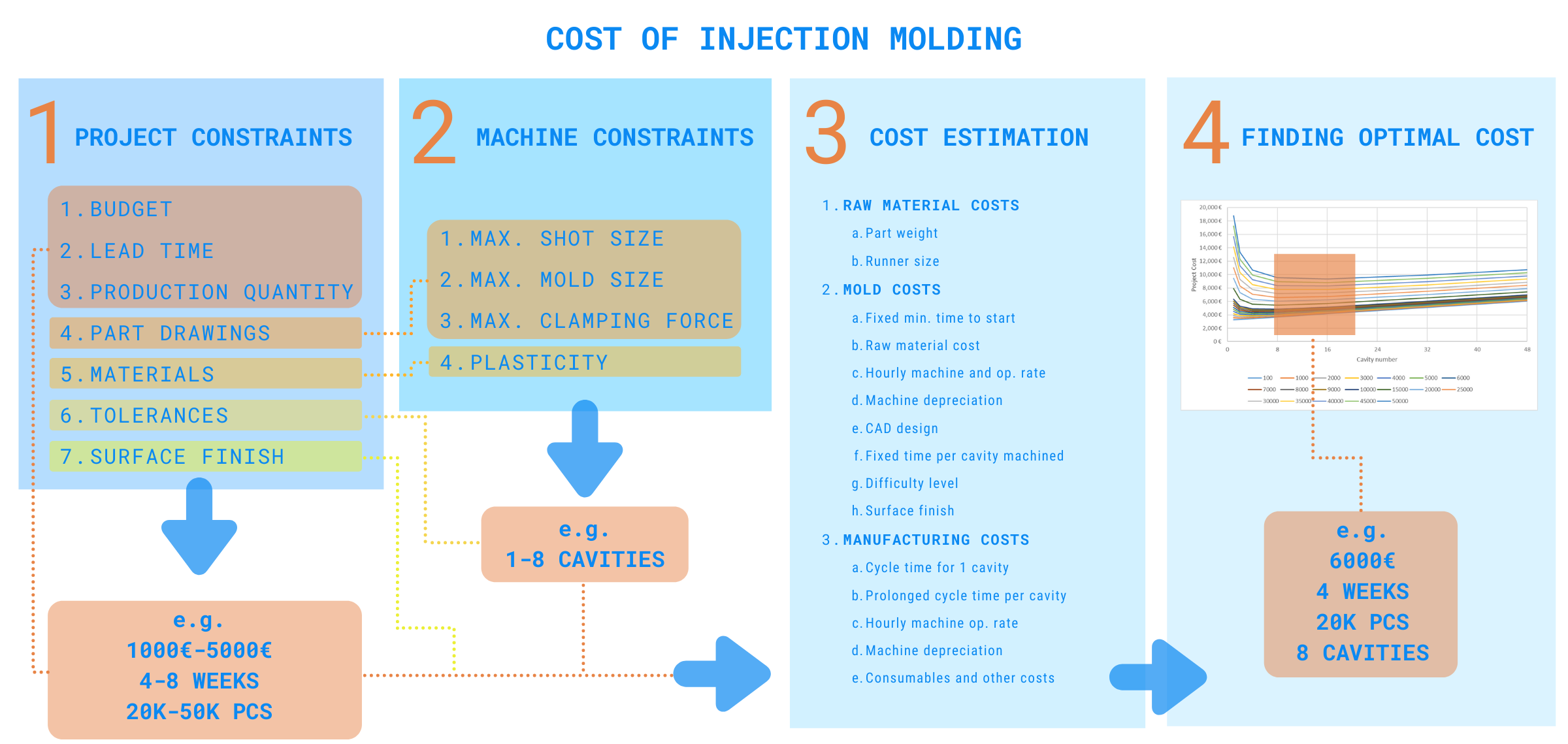
- 1 Total cost = Tooling CapEx + (Piece Price × Volume). A $20,000 mold adds $2.00/part at 10,000 units but only $0.04/part at 500,000 — the economics invert completely as volume scales.
- 2 SPI mold class determines upfront investment and program longevity: Class 105 aluminum bridge molds cost $2,000–$5,000 for 10,000 shots; Class 101 hardened steel production tools run $50,000–$100,000+ for 1,000,000+ shots.
- 3 Cycle time drives ~60% of piece price; cooling drives ~80% of cycle time. Material adds $0.10–$0.25/part for a 50 g commodity-resin part, scaling to $4.00–$6.00/part for PEEK components.
- 4 Four DFM decisions — uniform walls, cored sections, undercut elimination, and cavity count optimization — can reduce total program cost by 30–50% without changing functional design.
Injection molding quotes are not what they appear. A supplier with a lower piece price but a mismatched mold grade can cost more over a three-year production program than the supplier whose quote initially looks expensive. Understanding every layer of the cost model — tooling grade, material, machine time, and design overhead — is how procurement teams make sourcing decisions that survive contact with production reality.
The Two-Part Cost Formula Every Buyer Needs
Every injection molding program has two cost pools that move in opposite directions as volume increases:
Tooling is a fixed, one-time investment. Piece price is variable — paid on every shot. As volume grows, tooling amortization per part shrinks toward zero while piece price becomes the entire cost structure. Buyers who focus only on piece price often select a low-grade mold that wears out mid-program, forcing a premature re-tool at 3–5× the original mold cost and erasing all piece-price savings.
According to Xometry’s injection molding cost analysis, cycle time accounts for approximately 60% of final piece price, and within cycle time, cooling accounts for roughly 80% of total cycle time. Every unnecessary second of cooling is a per-part cost that compounds across the entire production run.
Piece price is composed of five elements: resin material (including colorant, glass fiber, or flame-retardant additive), machine time (press tonnage × cycle time × hourly rate), labor and handling, secondary operations (painting, ultrasonic welding, pad printing), and scrap-rate allocation — industry average 3–5% of shots. Machine hourly rates scale with press size: small presses under 100 tonnes run $20–$40/hr; mid-range 100–500 tonne presses run $40–$80/hr; large presses above 500 tonnes reach $80–$150/hr.
SPI Mold Classification: Matching Grade to Volume
The SPI mold classification system provides a standardized framework for specifying mold quality, steel grade, and expected service life. Selecting the wrong class is the most common source of mid-program cost shock.
| SPI Class | Steel / Material | Typical Tooling Cost | Shot Life | Best For |
|---|---|---|---|---|
| Class 105 | Aluminum (6061 / 7075) | $2,000–$5,000 | 500–10,000 shots | Prototype, market validation, bridge production |
| Class 103 | P20 pre-hardened steel | $5,000–$25,000 | Up to 500,000 shots | Low-to-medium volume, non-abrasive resins |
| Class 102 | H13 / S136 hardened steel | $20,000–$60,000 | Up to 1,000,000 shots | High-volume, glass-filled resins, tight tolerances |
| Class 101 | H13 / 420SS fully hardened | $50,000–$100,000+ | 1,000,000+ shots | Automotive, mass production, fast-cycle optimized tools |
A Class 105 aluminum bridge mold is engineered for speed to first shot, not production longevity. Dimensional variation increases measurably after 5,000 shots as cavity surfaces wear. Specifying a Class 105 tool for a 200,000-unit program guarantees a mid-program retool that compounds the original tooling cost by 3–5× — erasing all initial savings.
Material selection also determines minimum mold class. Glass-filled resins — GF-PA66, GF-PBT, GF-PP — carry abrasive glass fibers that wear P20 soft steel cavities significantly faster than unfilled grades; Class 102 minimum is required for these materials. Corrosive resins such as PVC and flame-retardant ABS require stainless or nickel-plated cavities to prevent rust-induced surface pitting.
How Volume Flips the Economics
The table below models total cost per unit for a representative ABS consumer-product part (50 g shot weight) using a single-cavity $20,000 Class 103 tool, a mid-size 200-tonne press at $55/hr, and a 30-second cycle time. ABS resin at approximately $1.30/lb ($2.86/kg); 50 g shot yields $0.14 in material cost per part.
| Annual Volume | Tooling / Unit | Material / Unit | Machine + Labor | Total / Unit | Tooling Share |
|---|---|---|---|---|---|
| 5,000 | $4.00 | $0.14 | $0.46 | $4.60 | 87% |
| 50,000 | $0.40 | $0.14 | $0.46 | $1.00 | 40% |
| 500,000 | $0.04 | $0.14 | $0.46 | $0.64 | 6% |
The crossover point — where tooling amortization drops below material cost per unit — occurs at approximately 30,000–60,000 units for a mid-range $20,000 tool. Below that threshold, the most impactful cost decision is mold grade and design optimization, not piece-price negotiation. Above it, DFM decisions — wall thickness, shot weight, cycle time — become the dominant levers on total program cost.
Resin selection has an outsized impact at scale. Standard material cost benchmarks range from PP at approximately $0.90/lb ($1.98/kg) for commodity packaging to PC at $2.30/lb ($5.07/kg) for optical and structural components. High-performance resins carry a step-change premium: PEEK runs $80–$120/kg — roughly 50–60× the cost of PP — meaning resin alone represents $4.00–$6.00 per 50 g part before any processing cost.
Four DFM Levers That Reduce Program Cost
DFM review at the quoting stage is where the largest cost reductions are captured — before steel is ever cut. Four design decisions carry the highest leverage on total program cost:
1. Uniform wall thickness. Non-uniform walls create differential cooling rates, forcing the press to wait for the thickest section to solidify before ejection. Reducing an unnecessary 4 mm section to 2.5 mm saves approximately 8 seconds of cooling. For a 500,000-unit/year program on a $60/hr press, that saving is worth approximately $66,000 annually in machine cost reduction alone.
2. Coring out solid sections. Thick solid walls cause sink marks and require excessive cooling time. Replacing solid geometry with hollow walls and interior ribs cuts both shot weight and cycle time simultaneously. A 30% shot weight reduction on an ABS part running 500,000 units/year saves approximately $21,000–$25,000 in material cost annually — before accounting for cycle time improvement.
3. Eliminating undercuts. Each slider or lifter required to release an undercut adds $2,000–$8,000 to mold cost per feature, according to 2026 tooling cost benchmarks. Two sliders on a consumer housing add $4,000–$16,000 to the mold quote. Re-orienting the parting line or adding a small draft angle to the undercut face often eliminates the slider entirely at zero functional cost.
4. Cavity count optimization. Moving from single-cavity to 4-cavity tooling reduces machine time per part by approximately 75%, at a tooling cost premium of roughly 1.5–2×. The break-even point for the added tooling investment versus single-cavity production typically falls between 50,000 and 100,000 annual units for standard-size parts on mid-range equipment. Above that threshold, the multi-cavity premium is recovered within the first year.
Applied together, these four DFM levers can reduce total program cost by 30–50% over a three-year production horizon — without changing the part’s functional design, material specification, or required tolerances.
Get a Detailed Cost Estimate for Your Program
Share your part geometry, material specification, annual volume, and commercial requirements so LongTeam can confirm the review scope, assumptions, and quotation timing for your program.
Request a Mold Cost Estimate →What to confirm before supplier review
Use the drawing, material specification, expected demand, application conditions, and acceptance requirements to turn a general process discussion into a program-specific review.
- Are all suppliers quoting the same files and requirements?
- Which assumptions drive cycle, cavity output, and material usage?
- What work is excluded from tool and part prices?
- How does total cost change across demand scenarios?
Continue the engineering review
Use the related guides and capability pages to connect this topic to part geometry, tooling, molding, and qualification decisions.