What matters most
- Define stiffness, strength, impact, fatigue, creep, wear, and assembly loads.
- Document temperature, moisture, UV, chemical, electrical, and cleaning exposure.
- Set appearance, color, texture, shrinkage, dimensional, and conditioning requirements.
Turn application requirements into a grade specification
Evaluate the technical choice together with part requirements, tooling consequences, production controls, and the evidence required for approval.
Mechanical
Define stiffness, strength, impact, fatigue, creep, wear, and assembly loads.
Environment
Document temperature, moisture, UV, chemical, electrical, and cleaning exposure.
Part quality
Set appearance, color, texture, shrinkage, dimensional, and conditioning requirements.
Evidence
Request the grade datasheet, compliance declarations, change controls, and test plan.
Technical guide
The sections below retain the detailed design, tooling, process, and quality context needed to evaluate this topic beyond the summary.
Key Takeaways
- 1 Material choice is the earliest — and highest-leverage — decision in any injection molded part program: switching resins after tooling is cut requires revised gate strategy, adjusted shrinkage compensation, and often a new trial shot, adding weeks and thousands of dollars in unplanned cost.
- 2 PP and ABS cover the majority of global injection molding volume because they offer the best cost-to-performance ratio for commodity and light engineering applications — but neither survives chemical exposure, elevated temperatures, or high mechanical loads where PA66-GF or POM are the right answer.
- 3 PEEK costs 20–50× more per kilogram than commodity resins. It is the right choice for specific extreme-environment applications — but specifying it for parts that PA66-GF30 can handle is one of the most expensive engineering oversights in plastics procurement.
- 4 Mold design and material are interdependent: shrinkage rate determines cavity compensation factors, and the selected resin’s processing temperature, viscosity, and moisture sensitivity all directly drive gate type, runner sizing, cooling time, and required drying protocols.
The Decision That Locks In Part Cost Before a Mold Is Designed
Resin selection happens earliest and changes the most downstream. Choose the wrong material and you face a compounding chain of problems: a gate placed for ABS viscosity may not fill at all with higher-viscosity PC substituted by engineering later; a shrinkage rate tuned for PP produces out-of-tolerance parts if the material switches to POM mid-program. According to Fictiv’s engineering guide, material properties affect not just part performance but wall thickness targets, gate strategy, cooling time, and ejection force — every parameter that determines total per-unit cost.
The global injection molding market was valued at approximately USD 335 billion in 2025, growing at 5.8% CAGR, driven by automotive lightweighting, medical device miniaturization, and consumer electronics — three sectors with radically different material requirements. This guide walks through the eight resins LongTeam engineers most commonly evaluate and provides the comparison data needed to make the right choice before committing to tooling.
Properties at a Glance: Eight Resins Compared
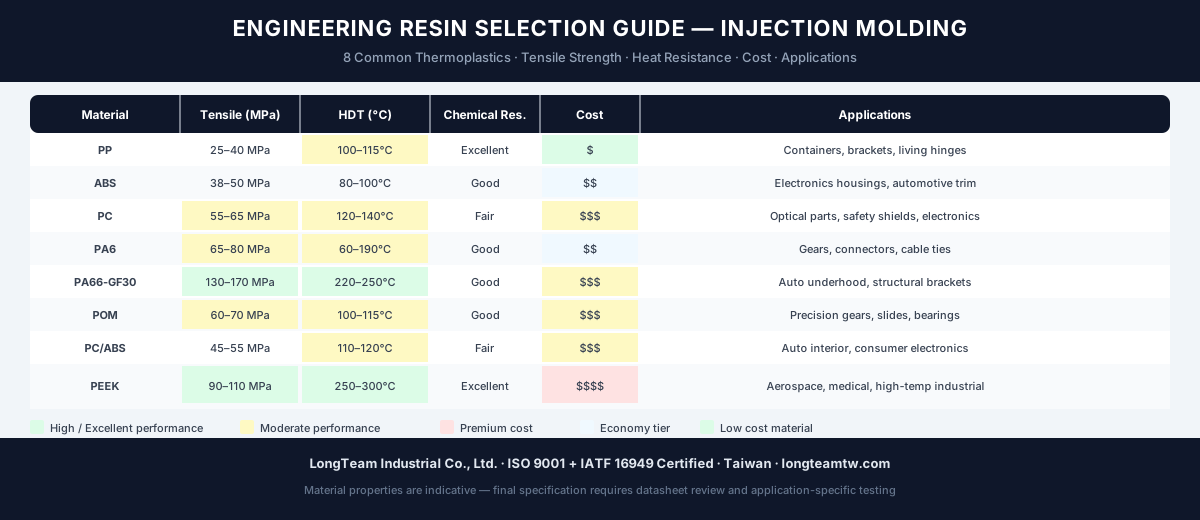
The table below consolidates key mechanical and processing properties. Tensile strength and heat deflection temperature (HDT) data sourced from ZetarMold’s thermoplastic comparison and Protolabs’ material selection guide. Cost ratings are relative to commodity PP (baseline = $).
| Material | Tensile Strength | HDT (0.45 MPa) | Shrinkage | Chemical Resistance | Relative Cost |
|---|---|---|---|---|---|
| PP | 25–40 MPa | 90–110°C | 1.0–2.5% | Excellent | $ |
| ABS | 30–50 MPa | 85–100°C | 0.4–0.7% | Moderate | $ |
| PC | 55–75 MPa | 135–145°C | 0.5–0.7% | Limited | $ |
| PA6 / PA66 | 70–85 MPa | 70–120°C | 0.6–1.4% | Good | $ |
| POM (Acetal) | 60–70 MPa | 110–130°C | 1.8–2.0% | Good | $ |
| PC / ABS Blend | 45–60 MPa | 110–130°C | 0.4–0.7% | Moderate | $ |
| TPE / TPU | 10–50 MPa | 50–80°C | 1.0–2.5% | Moderate | $ |
| PEEK | ≥100 MPa (unfilled) | 160°C+ (300°C+ filled) | 0.4–0.5% | Excellent | $$$ |
Decision Framework: Matching Material to Application
1. Temperature: The First Knockout Criterion
If your part must survive above 130°C in continuous use — under-hood automotive, industrial heat exposure, sterilization cycles — PP and ABS are immediately eliminated. PC handles up to 135–145°C before deforming under load. PA66 with 30% glass fill extends continuous service to approximately 120°C with significantly higher tensile strength. Parts operating continuously above 200°C narrow to PEEK and a handful of specialty resins (PPS, PEI) at correspondingly higher cost. According to ZetarMold’s materials analysis, PEEK retains structural integrity at continuous use temperatures up to 250°C — a capability no other thermoplastic in this guide matches.
2. Chemical Exposure: Eliminate Before Overspecifying
PC’s limited chemical resistance is one of the most common specification errors in injection molded part design. It crazes rapidly on contact with many cleaning agents, lubricants, and organic solvents — eliminating it from food-processing equipment, fuel system components, and chemical handling applications. For these use cases, PP or POM are the correct starting points. Xometry’s material guide notes that PP’s strong chemical resistance to acids, bases, and organic solvents makes it the default for medical containers, laboratory equipment, and chemical-contact housings.
3. Mechanical Load: Stiffness and Fatigue Life
For load-bearing structural parts — gears, snap-fit assemblies, brackets under dynamic load — ABS and PP are typically undersized. PA66-GF30 is the workhorse for most structural injection molded components: glass-filled grades deliver tensile strengths of 140–180 MPa at 1.5–2× the cost of commodity resin, per ZetarMold. POM is preferred for bearing and gear applications due to its self-lubricating surface and fatigue resistance under cyclic load. Reserve PEEK for applications that simultaneously require extreme temperature, chemical resistance, and high mechanical loading — surgical instruments, aerospace fasteners, high-speed bearing components.
4. Cosmetics and Dimensional Precision
Semi-crystalline resins (PP, PA, POM, PEEK) shrink significantly more than amorphous resins (ABS, PC, PMMA) and can exhibit anisotropic shrinkage when glass-filled — shrinking more in one direction than another. This complicates cavity compensation and makes tight tolerances harder to hold. For precision housings with Class A surfaces and tight feature-to-feature tolerances, amorphous resins like ABS and PC/ABS blends are preferred: their lower, more isotropic shrinkage (0.4–0.7%) allows tighter cavity sizing with predictable outcomes. Protolabs’ design guidelines confirm that PP’s 1.0–2.5% shrinkage range requires wider tolerance bands than ABS across equivalent part geometries.
Resin Cost Is Never the Whole Story
Choosing a cheaper resin to reduce material cost can be false economy. PP’s 1.0–2.5% shrinkage compensation requires wider tolerances in the mold — meaning cavity steel must be cut conservatively then adjusted after first trial shots. ABS’s tighter 0.4–0.7% shrinkage often reduces the number of T2 trial cycles needed, directly compressing total tooling cost. Nylon’s moisture sensitivity requires pre-molding drying at 80–90°C for 4–8 hours; omitting this step causes splay defects, silver streaks, and molecular degradation that produce scrap — a process cost that doesn’t appear on the raw material line item. PEEK’s 20–50× price premium is cited by ZetarMold as its primary barrier to specification, and its processing requires mold temperatures of 160–200°C, barrel temperatures up to 400°C, and dedicated tooling to prevent cross-contamination. For the right application these costs are entirely justified. For the wrong one, PA66-GF30 resolves the requirement at roughly 80% lower total cost.
Need a Material Recommendation for Your Part?
LongTeam’s engineering team can evaluate material selection against temperature, chemical exposure, mechanical loading, surface finish, and shrinkage requirements. Submit the part geometry and application details so the team can confirm the recommendation, quotation scope, and response timing.
Contact LongTeam →What to confirm before supplier review
Use the drawing, material specification, expected demand, application conditions, and acceptance requirements to turn a general process discussion into a program-specific review.
- Which exact resin grade is proposed?
- What service environment and useful-life conditions apply?
- Which additives, colorants, fillers, or recycled content are permitted?
- What evidence approves a material substitution?
Continue the engineering review
Use the related guides and capability pages to connect this topic to part geometry, tooling, molding, and qualification decisions.