What matters most
- Map load direction, creep, impact, fatigue, temperature, moisture, and assembly conditions.
- Review gate location, flow paths, weld lines, ribs, thickness, and where fibers are likely to align.
- Consider abrasion, vents, gates, runners, surface, cooling, steel, and maintenance.
Design for directional material behavior
Evaluate the technical choice together with part requirements, tooling consequences, production controls, and the evidence required for approval.
Loads
Map load direction, creep, impact, fatigue, temperature, moisture, and assembly conditions.
Flow and orientation
Review gate location, flow paths, weld lines, ribs, thickness, and where fibers are likely to align.
Tooling
Consider abrasion, vents, gates, runners, surface, cooling, steel, and maintenance.
Validation
Use production-molded specimens or parts to test critical directions, conditioning, dimensions, and function.
Technical guide
The sections below retain the detailed design, tooling, process, and quality context needed to evaluate this topic beyond the summary.
Key Takeaways
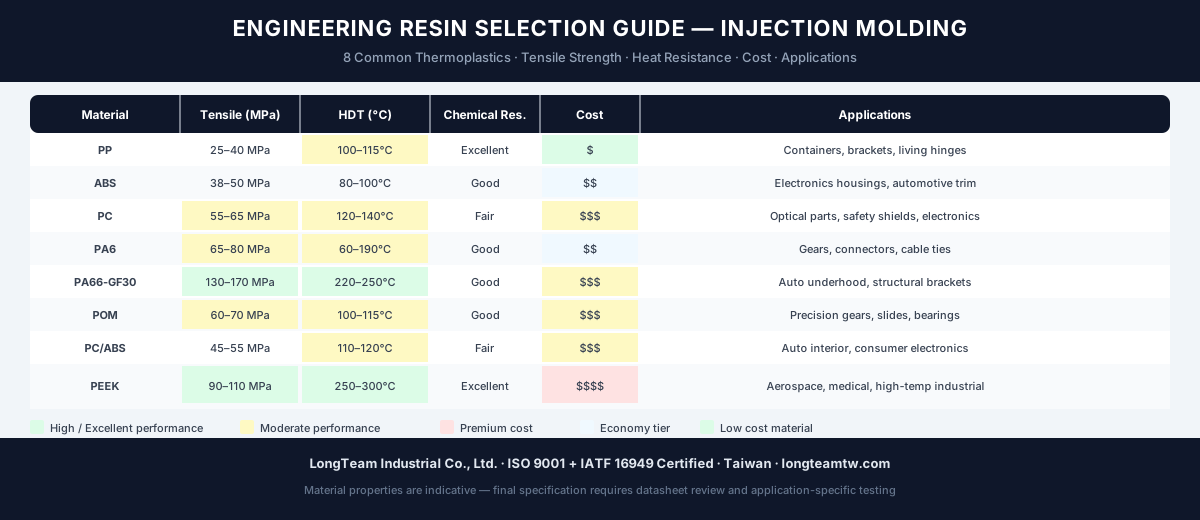
- 1 Adding 30% glass fiber to PA66 roughly doubles tensile strength (80–95 MPa to 170–190 MPa) and raises the heat deflection temperature from 90°C to over 250°C — making GF30 grades the standard choice for under-hood automotive structural parts.
- 2 Fiber reinforcement introduces anisotropic shrinkage: PA66 GF30 shrinks 0.2–0.5% in the flow direction but 0.8–1.5% across it — versus near-uniform 1.5–2.5% in unfilled PA66. Mold tooling must be dimensioned and gated to compensate.
- 3 Weld lines are a critical weakness in glass-filled parts: tensile strength at the weld drops to 60–70% of bulk material values because fibers align perpendicular to the flow front at the merge point. Gate location must keep weld lines away from structural load paths.
- 4 Glass fiber is highly abrasive — molds for GF grades require hardened tool steel (H13 at HRC 48–52 or S136 stainless) rather than the P20 pre-hardened steel used for unfilled grades, or gate erosion and cavity wear will shorten mold life dramatically.
Fiber-reinforced thermoplastics — most commonly glass-filled nylon (polyamide) grades — are the structural backbone of injection-molded automotive, electrical, and industrial components. PA66 GF30 alone appears in tens of thousands of part specifications annually: bracket systems, connector housings, intake manifold components, pump bodies, and structural clips where an unfilled polymer simply cannot deliver the stiffness and temperature resistance the application requires. Yet glass fiber changes not just the properties of the finished part — it changes how you design the part, how you specify the mold, and what tolerances you can realistically hold.
What Fiber Reinforcement Actually Does to Material Properties
Short glass fibers (10–30% by weight) dispersed in a nylon matrix dramatically improve stiffness and thermal performance while trading off some impact strength and translucency. The fibers act as internal load-bearing elements: under tensile stress, the polymer matrix transfers load to the stiffer glass, and the composite outperforms the matrix alone by a factor of two or more. According to ZetarMold’s nylon molding guide, PA6 GF30 reaches 160–175 MPa tensile strength versus 70–85 MPa unfilled, while HDT climbs from 65°C to over 200°C — a transformation that moves nylon from a general-purpose engineering plastic into a metal-replacement structural material.
| Grade | Tensile Strength (MPa) | Flexural Modulus (MPa) | HDT @ 1.8 MPa (°C) | Mold Shrinkage — Flow / Transverse |
|---|---|---|---|---|
| PA6 (unfilled) | 70–85 | 2,500–3,000 | 65 | 1.0–2.0% / 1.2–2.5% |
| PA6 GF30 | 160–175 | 9,000–11,000 | 200+ | 0.2–0.5% / 0.8–1.5% |
| PA66 (unfilled) | 80–95 | 2,800–3,200 | 90 | 1.5–2.5% / 1.8–3.0% |
| PA66 GF30 | 170–190 | 10,000–12,000 | 250+ | 0.2–0.5% / 0.8–1.5% |
| PP GF30 | 90–110 | 5,500–7,000 | 145–160 | 0.3–0.6% / 1.0–1.8% |
| PC GF20 | 100–120 | 6,000–7,500 | 145–155 | 0.1–0.3% / 0.4–0.8% |
Data sourced from ZetarMold and Boyi Prototyping material guides. Carbon-filled grades (CF10–CF20) deliver even higher stiffness than GF counterparts but at 3–5× the material cost, with fiber orientation sensitivity that limits their effectiveness in injection-molded parts — carbon fibers float randomly in the melt, so the alignment advantage that makes CFRP laminates exceptional is largely lost in an injection-molded matrix.
Three Processing Realities Engineers Often Discover Too Late
The mechanical property gains of glass reinforcement come with processing requirements that differ materially from unfilled grades. Missing any of these three frequently causes first-shot quality failures or unexpected tooling costs.
1. Moisture must be driven out — more aggressively than unfilled nylon
Polyamide is hygroscopic. At the melt temperatures required for GF grades (PA66 GF30 runs at 270–295°C), even trace moisture (above 0.2% by weight) hydrolyzes the nylon chains, causing irreversible molecular weight loss. The resulting part looks cosmetically acceptable but loses 20–30% of tensile strength — a silent failure mode. Per ZetarMold’s processing guidelines, GF nylon grades require drying at 80–90°C for 4–6 hours in a dehumidifying dryer with dew point below −30°C. Standard hopper dryers at ambient dew points are insufficient for GF grades in humid environments.
2. Weld lines are significantly weaker in fiber-reinforced grades
A weld line forms wherever two flow fronts meet in the cavity — downstream of a core pin, in a multi-gate tool, or through a feature that splits the flow. In unfilled nylon, weld lines are a cosmetic and modest structural concern. In GF grades, they are a critical engineering risk: according to fiber-reinforced molding guides, tensile strength at a weld line drops to 60–70% of bulk material values because glass fibers align perpendicular to the flow front at the merge point rather than along the load path. For any structural application, gate placement analysis (or mold flow simulation) must confirm that weld lines do not fall on load-bearing features, mounting bosses, or fatigue-prone thin sections.
3. Anisotropic shrinkage requires adjusted mold dimensions and tolerances
Unfilled nylon shrinks relatively uniformly in all directions (1.5–2.5% for PA66). Glass fiber dramatically changes this: fibers align along the flow direction during injection, physically restraining shrinkage along that axis while leaving the cross-flow direction comparatively unconstrained. The result is anisotropic shrinkage — PA66 GF30 shrinks only 0.2–0.5% in the flow direction but 0.8–1.5% across it. This differential creates internal stress and part warpage unless the mold cavity is dimensioned to compensate for the direction-specific shrinkage values, and gate location is chosen to control the dominant flow direction relative to the part’s critical dimensional axes.
Mold Design Adjustments Required for GF Grades
Glass fibers are highly abrasive. Silica (the primary constituent of E-glass fibers) has a Mohs hardness of 7 — harder than most unhardened steels. This means every kilogram of GF compound that passes through the gate and fills the cavity is abrading the gate land, runner junction, and cavity surface. According to mold steel selection guidelines for nylon grades, the practical tooling requirements for GF grades differ significantly from unfilled grades.
| Design Element | Unfilled Nylon (PA6 / PA66) | Glass-Filled Grade (GF15–GF50) |
|---|---|---|
| Mold Steel | P20 pre-hardened (~30 HRC) | H13 hardened (HRC 48–52) or S136 stainless |
| Gate Size | Standard (0.5–1.0 mm for sub-gates) | 10–20% larger to reduce shear and fiber breakage at gate |
| Runner Design | Standard round or trapezoidal | Full-round preferred; larger diameter to reduce shear degradation of fibers |
| Mold Temperature | 40–60°C | 80–120°C for PA66 GF30 (higher = better fiber wetting and surface finish) |
| Surface Finish | SPI A1–A3 achievable | SPI B2 practical maximum — fibers at surface degrade polish regardless of cavity finish |
| Venting | Standard 0.02–0.03 mm vent depth | More critical — faster fill speeds for GF grades demand adequate venting to prevent diesel effect burns |
The financial implication of specifying the wrong tool steel is significant: gate erosion on an unhardened P20 tool running PA66 GF30 at high volume can require gate insert replacement every 50,000–100,000 shots, whereas a correctly specified H13 gate insert at the same volumes runs to 500,000–1,000,000 shots before maintenance. This is a 5–10× difference in tooling maintenance cost over a program life.
When to Specify Glass-Filled vs. Unfilled vs. Carbon-Filled
The decision between unfilled, glass-filled, and carbon-filled grades is primarily driven by the load and temperature environment the part operates in, balanced against unit cost and cosmetic requirements. Unfilled grades are appropriate where flexibility, paintability, or optical clarity is needed. Glass-filled grades are the cost-effective choice for structural, load-bearing, or elevated-temperature applications. Carbon-filled grades are justified only where weight is a critical constraint and budget supports a 3–5× material premium — and even then, the random fiber orientation in injection molding limits carbon’s effectiveness compared to continuous-fiber composite processes. For the majority of automotive structural brackets, connector housings, and fluid system components, PA66 GF30 is the de facto standard because it balances material cost, processing reliability, and performance.
In practice, glass fiber content of 30 wt% (GF30) represents the optimal performance-to-processability ratio for most programs. Higher loading (GF50) further improves stiffness and HDT but sharply increases melt viscosity, requires even more aggressive drying, accelerates mold wear faster, and worsens weld line severity. Programs requiring GF50 or above should be reviewed carefully against the tooling maintenance and processing cost implications before committing to a grade specification.
Working With Glass-Filled Materials? Start With a DFM Review.
LongTeam Industrial holds ISO 9001 and IATF 16949 certification and regularly molds PA66 GF30, PA6 GF30, PP GF30, and other fiber-reinforced grades for automotive structural programs. Our DFM review identifies weld line risks, gate location relative to load paths, and shrinkage compensation requirements before tooling is cut — the stage where changes cost time, not money. Contact our engineering team to discuss your fiber-reinforced component requirements.
Discuss Your Glass-Filled Part Program →What to confirm before supplier review
Use the drawing, material specification, expected demand, application conditions, and acceptance requirements to turn a general process discussion into a program-specific review.
- Which exact reinforced grade and conditioning state apply?
- How do load and expected fiber orientation align?
- Where will weld lines or anisotropic shrinkage affect the part?
- Which tests use production-representative molded parts?
Continue the engineering review
Use the related guides and capability pages to connect this topic to part geometry, tooling, molding, and qualification decisions.