What matters most
- Consider abrasiveness, corrosion, outgassing, flame retardants, processing temperature, and color changes.
- Define polish, texture, optical or cosmetic expectations, hardness, and repair constraints.
- Select cavity, core, slide, insert, wear plate, gate, and base materials for their different duties.
Specify steel by component and duty
Evaluate the technical choice together with part requirements, tooling consequences, production controls, and the evidence required for approval.
Resin
Consider abrasiveness, corrosion, outgassing, flame retardants, processing temperature, and color changes.
Surface
Define polish, texture, optical or cosmetic expectations, hardness, and repair constraints.
Tool component
Select cavity, core, slide, insert, wear plate, gate, and base materials for their different duties.
Lifecycle
Connect demand, maintenance, spares, welding, coatings, heat treatment, and transfer requirements.
Technical guide
The sections below retain the detailed design, tooling, process, and quality context needed to evaluate this topic beyond the summary.
Key Takeaways
- 1 Mold steel grade drives 30–40% of total tooling cost and determines shot life, surface finish capability, and resistance to corrosive or abrasive resins — making it the most consequential specification decision at RFQ time.
- 2 P20 (HRC 28–33) is the cost-effective default for commodity resins and volumes under 500,000 shots; H13 (HRC 48–52) is mandatory for glass-filled or abrasive resins targeting 1M+ shots — where P20 shows measurable wear after 200,000–300,000 shots.
- 3 S136 stainless steel (13% Cr) is the only standard grade for corrosive resins (PVC, POM, FR-ABS) and mirror-finish optical or medical parts (Ra ≤ 0.025 µm) — a $3,000–$8,000 upfront premium that avoids $5,000–$15,000 cavity repair costs mid-run.
- 4 NAK80 (HRC 37–43, pre-hardened) bridges the gap between P20 and through-hardened grades — no post-machining heat treatment, superior weldability, and Class-A cosmetic polish for consumer electronics and automotive interior programs.
Injection mold steel selection is routinely treated as a back-office molder decision, but for tooling managers and procurement engineers, it is one of the most consequential choices in any new program. The steel grade your mold maker specifies determines how long the tool runs before a cavity repair is needed, whether it holds a mirror finish for optical or medical parts, and whether corrosive off-gassing from certain resins will pit the cavity walls mid-run. Specifying the wrong grade at RFQ time — typically a $3,000–$8,000 delta — can produce a $25,000 mid-run cavity repair and an unplanned production shutdown. Four grades cover the vast majority of production tooling requirements: P20, H13, S136, and NAK80.
The Four Grades: Hardness, Shot Life, and Cost
Steel grade accounts for 30–40% of total tooling cost according to ZetarMold’s tooling materials analysis. The grades are standardized under ISO 4957 tool steels and their AISI/SAE equivalents: P20 = DIN 1.2311, H13 = DIN 1.2344, S136 ≈ DIN 1.2083 (stainless), with NAK80 as a Daido Steel proprietary pre-hardened grade. Hardness values for H13 and S136 are post-heat-treatment; P20 and NAK80 are supplied pre-hardened.
| Grade | Hardness (HRC) | Shot Life | Surface Finish | Best-Fit Resins | Cost vs P20 |
|---|---|---|---|---|---|
| P20 | 28–33 | 300,000–500,000 | VDI 12–18 (satin) | ABS, PP, PE, PS (unfilled) | 1.0× (baseline) |
| H13 | 48–52 | 1,000,000+ | VDI 6–12 (semi-gloss) | GF-nylon, POM, PC, PPS, PEI | 1.5×–2.0× |
| S136 | 48–52 | 500,000–1,000,000 | VDI 0–3 (mirror, Ra ≤0.025 µm) | PVC, FR-ABS, POM, medical/optical | 2.0×–2.8× |
| NAK80 | 37–43 | 300,000–700,000 | VDI 3–9 (Class-A cosmetic) | ABS, PC, PMMA (cosmetic) | 1.4×–1.8× |
P20: The Workhorse for Commodity Programs
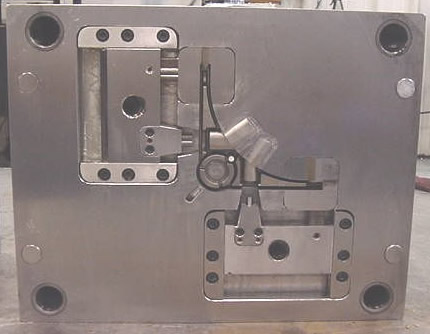
P20 is the industry baseline for prototype and medium-volume tooling. Pre-hardened to HRC 28–33, it requires no post-machining heat treatment — saving 5–10 working days on tool build time and eliminating dimensional distortion risk during heat treat. For unfilled commodity resins running fewer than 500,000 shots, P20 delivers acceptable dimensional stability and adequate surface finish for textured or painted cosmetic surfaces. It is not suited for glass-filled resins at production volumes: at 30% GF loading, P20 cavities show measurable wear (>0.02 mm gate depth) after 200,000–300,000 shots, forcing mid-run cavity replacement before the program target is met.
H13: The Durability Standard for High-Volume and Abrasive Resins
H13 (AISI H13, DIN 1.2344) is a chromium-molybdenum-vanadium hot-work tool steel reaching HRC 48–52 after vacuum hardening and double tempering. Its vanadium carbide content provides the wear resistance required for glass-filled, mineral-filled, and fiber-reinforced resins, maintaining dimensional tolerance beyond 1,000,000 shots under conditions where P20 fails at 200,000–300,000. The 5% chromium also provides partial corrosion resistance, and H13 handles mold temperatures above 300°C without tempering back — mandatory for high-temperature engineering resins (PPS, PEI, LCP). The cost premium of 1.5×–2.0× versus P20 (typically $1,500–$4,000 per mold) returns ROI within the first 300,000 additional shots through avoided cavity repairs alone.
S136: Mandatory for Corrosive Resins and Mirror Finishes
S136 (DIN 1.2083) is a 13% chromium stainless tool steel with the highest polishability of any standard mold grade — capable of mirror finish to Ra ≤ 0.025 µm (VDI 0–3). It is mandatory for two categories: resins that generate corrosive off-gases during processing (PVC, halogenated FR-ABS, POM which releases formaldehyde at mold temperatures), and optical or medical parts requiring Class-A surface finish. Uddeholm data sheets note S136 achieves Charpy impact toughness of ~20 J at HRC 50 versus H13’s ~28 J — the tradeoff between corrosion protection and toughness that limits S136 to non-impact applications. Upgrading from P20 to S136 adds $3,000–$8,000 per mold; a single cavity repair from PVC pitting costs $5,000–$15,000 and typically triggers a 3–4 week production interruption.
NAK80: The Class-A Cosmetic Specialist
NAK80 is a vacuum-degassed, Ni-Al-Cu-alloyed pre-hardened steel (Daido Steel proprietary grade) supplied at HRC 37–43 — filling the gap between P20 and fully through-hardened grades without requiring post-machining heat treatment. Its key advantages are superior weldability enabling in-situ cavity repair, excellent spark-erosion performance for fine EDM texturing, and Class-A cosmetic polish for consumer electronics bezels, automotive instrument panel components, and PMMA optical housings. Where P20 shows orange-peel at VDI 9–12, NAK80 reliably achieves VDI 3–6 on the same part geometry. It is not suited for abrasive or corrosive resins; for those applications, H13 or S136 remains the correct specification.
A Three-Factor Decision Framework
Steel grade selection resolves to three sequential questions that should be answered at DFM review — before tooling PO is issued:
-
1
Production Volume
Under 500,000 shots with unfilled commodity resin: P20 (or NAK80 if cosmetic). Over 1,000,000 shots, or any glass-filled or mineral-filled resin: H13. The break-even where H13’s premium returns ROI is approximately 300,000 additional shots at a $60/hr machine rate with P20 cavity replacement costs factored in.
-
2
Resin Chemistry
Any corrosive off-gas (PVC, halogenated FR additives, POM, certain PA66 grades at high temperatures): S136. Abrasive fillers (glass fiber >15%, mineral fill, carbon fiber): H13. Unfilled or lightly filled engineering resins: P20 or NAK80.
-
3
Surface Finish Requirement
Mirror/optical finish (Ra ≤ 0.05 µm, VDI 0–3): S136 only. Class-A cosmetic high-gloss (no sink, no gate witness): NAK80. Textured or painted surface: P20 or H13 sufficient.
For mixed requirements — for example, a high-volume (2M+ shot) cosmetic part in unfilled ABS — the established solution is a P20 mold base with H13 cavity inserts and NAK80 core inserts on the Class-A face. This hybrid approach, documented by Mantle 3D in their comprehensive tool steels guide, applies expensive steel only where the performance requirement actually exists — delivering H13 durability on wear faces and NAK80 finish quality on cosmetic surfaces without the cost of upgrading the entire assembly.
LongTeam’s Steel Specification Practice
LongTeam’s standard specification for automotive and electronics programs uses H13 vacuum-hardened cavity inserts on P20 mold bases. The cavity inserts carry the dimensional and surface finish load; the P20 base provides a cost-effective structural foundation with no shot life constraint. This split-grade architecture delivers H13 durability where it is needed without paying S136 prices across the entire mold assembly.
For medical device components, transparent optical housings, or any part processed in a corrosive resin family, LongTeam’s DFM review recommends S136 cavity inserts with a written justification referencing the resin data sheet and the applicable ISO 4957 equivalency. For consumer electronics and Class-A automotive interior programs, NAK80 is evaluated at DFM for cavity faces requiring VDI 0–6 finish with in-situ weld repair capability. Steel grade is finalized before the tooling PO — when the cost of changing the specification is a line item, not a mid-run surprise.
Discuss Mold Steel for Your Program
LongTeam’s engineers review steel grade, cavity layout, and cooling architecture at DFM — before PO, so you have the data to make an informed tooling investment decision. If your program is still in specification, now is the right time to have this conversation.
Request a DFM ConsultationWhat to confirm before supplier review
Use the drawing, material specification, expected demand, application conditions, and acceptance requirements to turn a general process discussion into a program-specific review.
- Which exact steel grade, supplier, condition, and hardness are quoted?
- Which mold components use each material?
- What resin and finish risks drove the selection?
- How will steel identity, heat treatment, repair, and substitutions be recorded?
Continue the engineering review
Use the related guides and capability pages to connect this topic to part geometry, tooling, molding, and qualification decisions.