What matters most
- Control resin identity, moisture, lot information, and preparation conditions.
- Separate fill, pack, gate-seal, cooling, and recovery decisions during development.
- Connect process signals to dimensions, appearance, weight, and functional results.
Build a process that can be transferred and monitored
Evaluate the technical choice together with part requirements, tooling consequences, production controls, and the evidence required for approval.
Material preparation
Control resin identity, moisture, lot information, and preparation conditions.
Process study
Separate fill, pack, gate-seal, cooling, and recovery decisions during development.
Measurement
Connect process signals to dimensions, appearance, weight, and functional results.
Control plan
Define limits, reaction plans, change control, and retained records for production.
Technical guide
The sections below retain the detailed design, tooling, process, and quality context needed to evaluate this topic beyond the summary.
Key Takeaways
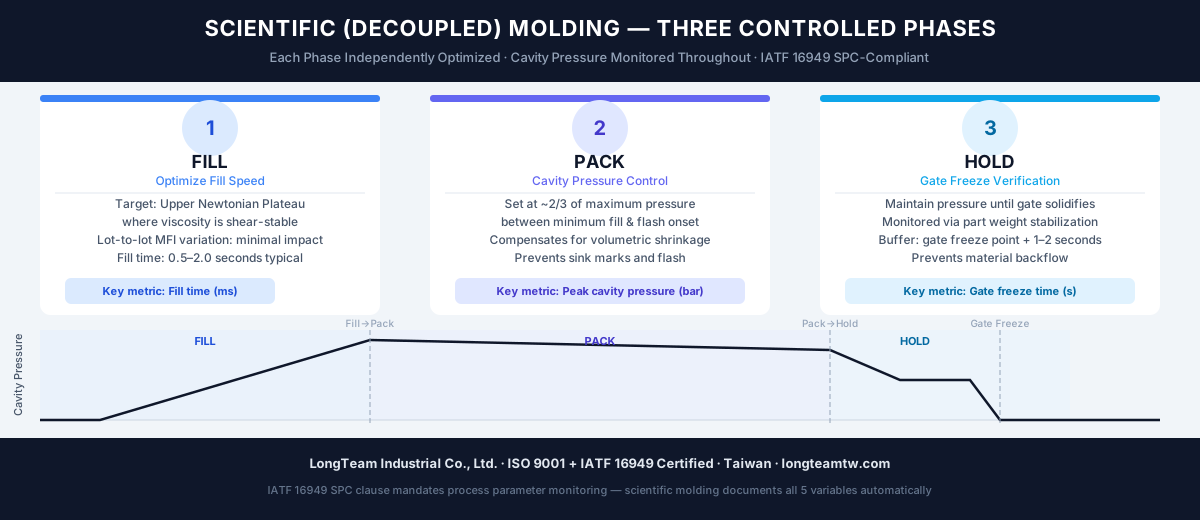
- 1 Scientific molding — also called decoupled molding — separates injection into three independently optimized phases (fill, pack, hold), eliminating the operator guesswork that drives shot-to-shot variation in conventional production setups.
- 2 Automotive process-capability targets are defined by customer requirements and the control plan. Confirm the required study and acceptance threshold for each critical characteristic instead of inferring one universal Cpk value from IATF 16949 certification.
- 3 Cavity pressure monitoring delivers the only real-time quality view inside the mold cavity — catching viscosity shifts from incoming resin lot variation before a single defective part leaves the press.
- 4 Inline process monitoring can create objective records for process-window review, tool transfer, and change control. PPAP timing still depends on customer requirements, submission level, evidence quality, and corrective-action cycles.
What Is Scientific Molding — and Why Does It Matter?
Conventional injection molding process setup relies heavily on operator experience: a technician adjusts temperature, pressure, and speed until samples look acceptable, then locks in those settings. The result is a process adequate under controlled conditions but fragile against real-world variation — a new resin lot, an ambient temperature swing, or gradual mold wear can shift critical dimensions without any automated detection.
Scientific molding, also known as decoupled molding (a methodology pioneered by RJG Inc. and widely adopted across precision injection molding globally), takes a fundamentally different approach. It treats each phase of the injection cycle — fill, pack, and hold — as a separate, scientifically characterized variable. Decisions are data-driven and process windows are documented with statistical precision, not written down as a single operator-set point.
According to Protolabs’ scientific molding guide, the methodology targets three parameters with particular rigor: optimum fill speed (operating at the upper Newtonian plateau where viscosity is shear-stable and resin lot-to-lot differences have minimal impact), optimum hold pressure (approximately two-thirds between the minimum fill pressure and flash onset), and optimum hold time (verified via gate freeze analysis and part weight stabilization). Together, these three parameters define a process reproducible across shifts, machines, and material lots — without relying on operator judgment to sustain it.
The Five Variables Scientific Molding Controls
Scientific molding programs monitor and document five core process variables every production cycle. These are the same variables that IATF 16949’s SPC clause requires automotive suppliers to track for critical-to-quality features — meaning that every production run generates the objective data needed to support PPAP submissions and customer-facing Cpk reports.
-
1
Melt Temperature. Controls polymer viscosity, molecular orientation, and fiber alignment in reinforced grades. Deviations of ±5°C can measurably shift tensile strength in glass-filled nylons. Documented melt temperature windows form part of the process FMEA and control plan.
-
2
Mold Temperature. Governs cooling rate, crystallinity in semi-crystalline resins (PP, PA66, POM), and surface finish consistency. Inconsistent mold temperature is a primary driver of warpage and dimensional scatter across cavities in multi-cavity tools.
-
3
Fill Time. Targeted at the upper Newtonian plateau — the shear rate at which viscosity becomes insensitive to speed variation. Operating in this plateau allows material lot-to-lot viscosity differences to have minimal impact on part geometry and molecular orientation.
-
4
Pack and Hold Pressure. Compensates for volumetric shrinkage as molten plastic cools. Scientific molding characterizes the full pressure curve — from minimum fill to flash onset — and sets hold pressure at the optimal point within that documented envelope, preventing both sink marks (under-pack) and flash or ejection problems (over-pack).
-
5
Cavity Pressure. The most direct quality indicator — measuring pressure inside the mold rather than at the machine barrel. Cavity pressure sensors detect short shots, flash conditions, and viscosity deviations the instant they occur, enabling automatic reject sorting before defective parts reach outbound inspection.
When a new resin lot arrives with a higher melt flow index than the previous batch — common even within a single grade from the same supplier — cavity pressure telemetry catches the fill-speed deviation within the first shots. Production lot data confirms that pressure-at-transfer correlates directly with resin viscosity, making cavity pressure the most reliable early-warning signal for incoming material quality issues.
Conventional Molding vs. Scientific Molding: A Direct Comparison
The table below contrasts conventional experience-based process setup with a scientific molding approach across six dimensions relevant to OEM supplier qualification. Data compiled from RJG Inc., Xometry’s IATF 16949 resource, and TeDe Solutions’ 2025 inline quality control analysis.
| Dimension | Conventional Molding | Scientific Molding |
|---|---|---|
| Process Setup | Technician experience; single set-point target | Data-driven DOE; documented process window with upper/lower bounds |
| Shot-to-Shot Consistency | Variable; dependent on operator vigilance and ambient conditions | SPC-tracked; Cpk monitored each production run |
| Defect Detection | Post-mold sampling; defects discovered after production batch | Real-time cavity pressure; automatic reject sorting in-cycle |
| Resin Lot Variation Response | Manual re-adjustment by technician (hours of downtime risk) | Automatic pressure-based compensation within documented process window |
| Scrap Rate Potential | Establish the program baseline before changing the process | Track scrap against the approved process window and investigate special-cause variation |
| PPAP Timeline | Timing depends on customer submission requirements and corrective-action cycles | A documented process window can make the evidence easier to review; no fixed approval time is implied |
How IATF 16949 and Scientific Molding Align
IATF 16949 does not prescribe a process called “scientific molding” or one universal Cpk target. It does require disciplined quality planning and evidence appropriate to the product, process, customer requirements, and identified risks. A scientific molding approach can support that work by defining a process window and producing repeatable data for review.
For supplier qualification, ask how the molder selects statistical methods, defines critical characteristics, documents the approved process window, and reacts to out-of-control conditions. Certification establishes a quality-system framework; the program-specific control plan, capability study, and production records show how that framework is applied to your part.
LongTeam holds ISO 9001 and IATF 16949 certifications. For programs that require them, the qualification plan can define the control plan, process FMEA, capability evidence, reaction instructions, and material-traceability records expected by the customer. Confirm the applicable characteristics, submission level, and reporting scope during quotation.
Need a Supplier Who Can Show You the Cpk Data?
For programs that require them, LongTeam can scope SPC control charts, process-capability reports, and resin-lot traceability to the customer’s supplier-qualification and production-audit requirements.
Request a Process Capability Discussion →What to confirm before supplier review
Use the drawing, material specification, expected demand, application conditions, and acceptance requirements to turn a general process discussion into a program-specific review.
- Which studies establish the process window?
- Which cavity or machine signals are monitored?
- How do signals connect to part acceptance?
- What happens when a parameter or result leaves its approved range?
Continue the engineering review
Use the related guides and capability pages to connect this topic to part geometry, tooling, molding, and qualification decisions.