What matters most
- Define clamp, injection, plasticizing, speed, pressure, position, parallel-motion, and control requirements.
- Match projected area, shot size, tie bars, mold dimensions, actions, utilities, and handling.
- Consider noise, oil, cleanliness, temperature control, energy measurement, and facility constraints.
Qualify the machine against the program
Evaluate the technical choice together with part requirements, tooling consequences, production controls, and the evidence required for approval.
Process need
Define clamp, injection, plasticizing, speed, pressure, position, parallel-motion, and control requirements.
Part and tool
Match projected area, shot size, tie bars, mold dimensions, actions, utilities, and handling.
Environment
Consider noise, oil, cleanliness, temperature control, energy measurement, and facility constraints.
Control
Verify maintenance, calibration, alarms, parameter security, process transfer, and backup capacity.
Technical guide
The sections below retain the detailed design, tooling, process, and quality context needed to evaluate this topic beyond the summary.
Key Takeaways
- 1 All-electric machines consume 40–70% less energy than comparable hydraulic presses — saving $13,000–$17,500 per machine annually at industrial electricity rates.
- 2 Electric servo drives deliver position repeatability within ±0.01 mm — 5× tighter than the ±0.05–0.1 mm typical of hydraulic systems — critical for precision medical and electronics parts.
- 3 Hydraulic machines hold 50.9% global market share in 2025 because they generate clamping forces up to 10,000+ tons — well beyond the ~650-ton ceiling of most commercial all-electric platforms.
- 4 Machine type directly determines cleanroom eligibility, noise level, and shot-to-shot consistency — making it one of the most important supplier qualification questions an OEM procurement team can ask.
When procurement engineers qualify a new injection molder, conversations typically focus on mold design, material certifications, and quality systems. Machine type rarely comes up — yet it governs energy cost, part-to-part repeatability, cleanroom eligibility, and maximum clamping force. This guide explains how all-electric, hydraulic, and hybrid presses differ technically, which applications each type serves best, and what questions to ask a potential molder before signing a supply agreement.
How Each Machine Type Works
Hydraulic machines use a continuously running pump to pressurize hydraulic fluid that drives the injection, clamping, and ejection axes. Because the pump runs throughout the full molding cycle — including dwell and idle periods — 25–40% of consumed energy is wasted when no mechanical work is being performed. A 200-ton hydraulic press typically draws 25–35 kW on average. The technology’s strength is raw force: hydraulic platforms routinely achieve clamping forces above 10,000 tons, making them the default choice for large automotive panels, appliance housings, and structural components that exceed the tonnage ceiling of electric platforms. Annual maintenance runs $3,000–$8,000 covering oil changes every 3,000–5,000 operating hours, filter replacement, and seal inspection.
All-electric machines replace every hydraulic axis with a servo motor driving a ballscrew or rack-and-pinion mechanism. Servo motors activate only when movement is required, consuming energy proportional to actual work performed. A 200-ton all-electric press draws just 10–15 kW on average — saving $13,000–$17,500 per machine per year at standard industrial electricity rates. In direct testing, Engel electric machines consumed 0.259 kWh/kg versus 0.353 kWh/kg for a comparable hydraulic press — a 27% reduction on a process-energy basis. Closed-loop servo control achieves injection positioning within ±0.01 mm. The trade-offs are capital cost (20–40% premium over hydraulic) and a clamping force ceiling of approximately 650 tons on most commercial platforms.
Hybrid machines pair an electric servo injection unit with a hydraulic clamping system, capturing most of the precision and energy savings of electric machines while extending clamping capacity to 4,000+ tons. Nissei’s FNX hybrid series uses 55% less hydraulic oil and achieves 40% lower energy consumption compared to a full-hydraulic press of equivalent size. Hybrids occupy the cost and noise midpoint between the two pure technologies, operating at 65–75 dB compared to 75–85 dB for hydraulic and 60–68 dB for all-electric platforms.
Side-by-Side Technical Comparison
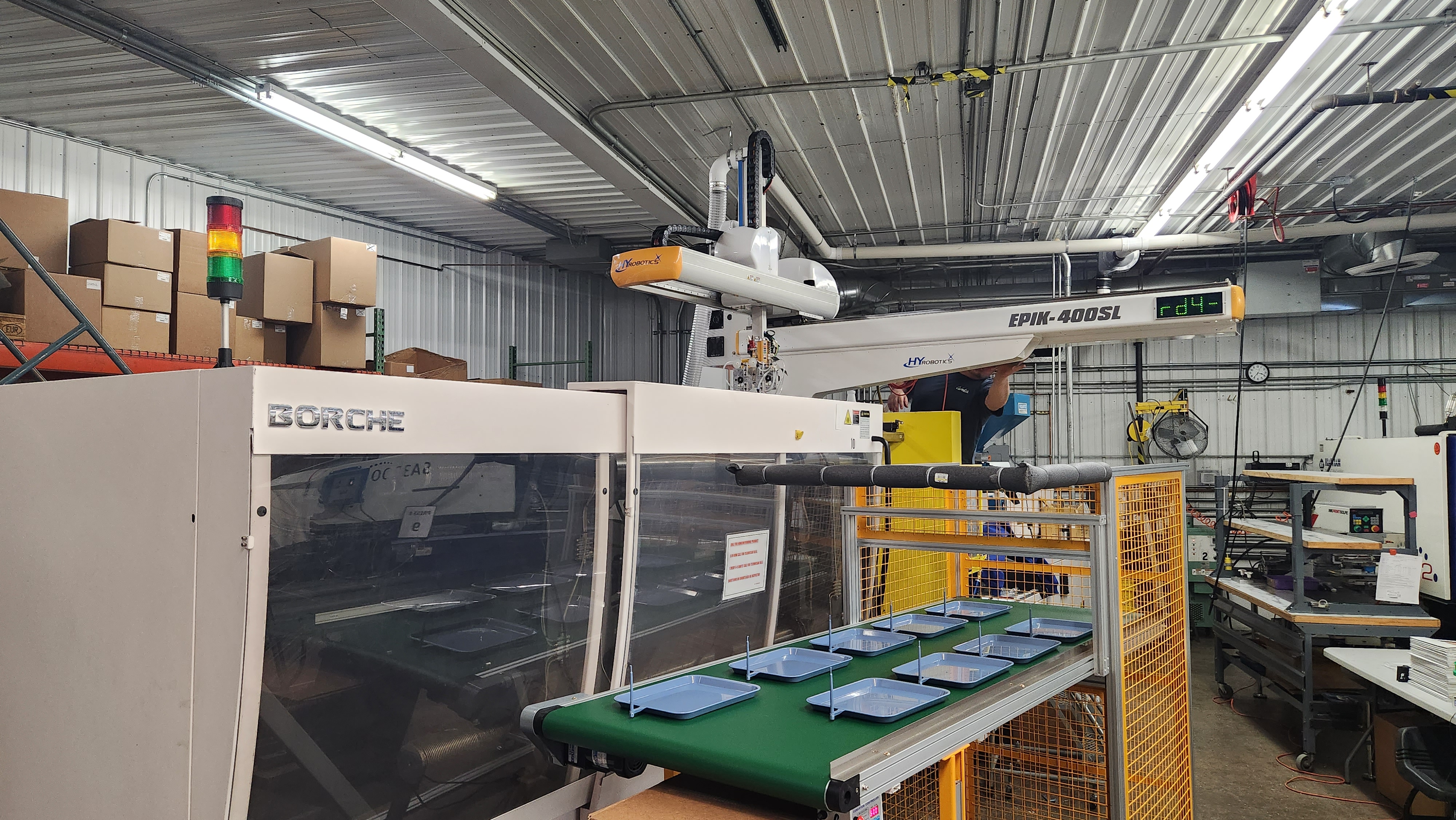
The table below summarizes published performance data across the three machine types for 200–400-ton class presses — the most common range for industrial and automotive injection molding programs:
| Parameter | Hydraulic | All-Electric | Hybrid |
|---|---|---|---|
| Avg. energy draw (200T) | 25–35 kW | 10–15 kW | 15–22 kW |
| Position repeatability | ±0.05–0.1 mm | ±0.01 mm | ±0.02–0.05 mm |
| Noise level | 75–85 dB | 60–68 dB | 65–75 dB |
| Cleanroom suitability | Limited (oil risk) | Excellent (oil-free) | Good (reduced oil) |
| Max clamp force | 10,000+ tons | ~650 tons | 4,000+ tons |
| Capital cost (200–400T) | $80K–$175K | $150K–$325K | $120K–$250K |
| Annual maintenance | $3,000–$8,000 | $1,000–$3,000 | $2,000–$5,000 |
| TCO advantage | Lowest upfront cost | Lowest lifetime cost (ROI 2–4 yrs) | Balanced |
Sources: Meadoworks (2025); Plastics Technology; Grand View Research IMM Market Report (2025)
Matching Machine Type to Application Requirements
Medical devices and cleanroom electronics: All-electric is the only viable choice for ISO class 7 or 8 cleanroom environments. Hydraulic oil contamination risk is a disqualifying factor under FDA 21 CFR Part 820 and EU MDR 2017/745 supplier requirements. Noise levels below 65 dB also align with occupational exposure standards for personnel on continuous 8-hour production shifts. Clean-room injection molding guidelines consistently specify oil-free electric machines as the baseline requirement.
High-tonnage structural and automotive parts: Hydraulic remains the correct choice for clamping forces above 650 tons — large bumper fascias, instrument panel carriers, door modules, and structural foam components. The lower capital cost also favors hydraulic for short-run tooling programs where machine utilization does not justify the electric capital premium.
Automotive precision and mixed programs: Hybrid presses occupy the practical sweet spot for automotive contract molders running mixed-tonnage programs. The electric injection axis delivers shot weight consistency required for tight-tolerance connector housings and clip systems, while the hydraulic clamp handles force demands from larger structural parts. Grand View Research (2025) notes that hybrid machines are gaining market share fastest in the automotive segment because of this versatility.
High-speed packaging and thin-wall: All-electric machines with injection speeds up to 800 mm/sec enable sub-3-second cycles for thin-wall food containers and closures. Tessy Plastics achieved sub-6-second cycles on a 385-ton all-electric press for PP connectors at $3/hr energy cost versus $8/hr for the equivalent hydraulic process — a $42,000 annual saving on a single machine.
Five Questions to Ask Your Molder About Their Machine Fleet
OEM procurement engineers increasingly treat machine fleet composition as a supplier qualification criterion, particularly as ESG reporting obligations require Scope 2 emissions data from manufacturing partners. These five questions surface the information that matters:
- What percentage of your production tonnage runs on all-electric or hybrid machines? A molder with 60%+ electric capacity signals an energy-efficiency posture that reduces per-part cost over a multi-year program and supports supply chain carbon reporting.
- What is the clamping force range of your all-electric fleet? Electric tonnage ceilings vary significantly by brand and model year; confirm the molder has the right capacity for your part without defaulting to a hydraulic machine.
- Do you measure and report energy consumption per job or per machine? Molders with ISO 50001 energy management systems or machine-level kWh tracking can provide documented data for Scope 2 supply chain reporting requirements.
- How is shot weight CV% monitored in production? Electric machines can achieve CV% below 0.05%; request SPC charts from a comparable production run rather than accepting general capability claims.
- Are any of your machines certified for cleanroom operation? If your part goes into a medical device or regulated electronics assembly, cleanroom qualification must be confirmed before any other supplier criteria are evaluated.
Partner With a Molder Who Understands Machine Selection
LongTeam evaluates injection-molding machine selection against each part’s tonnage, precision, process, and energy requirements. Our ISO 9001 and IATF 16949 quality systems incorporate machine-level process controls regardless of machine type, and our engineering team evaluates machine selection as part of every new program DFM review — matching tonnage, precision requirements, and energy targets to the right platform for your part.
Discuss Your Program RequirementsWhat to confirm before supplier review
Use the drawing, material specification, expected demand, application conditions, and acceptance requirements to turn a general process discussion into a program-specific review.
- Why was this machine selected for the tool and resin?
- Does the press operate within an appropriate shot and clamp window?
- How are settings, maintenance, and calibration controlled?
- What backup plan exists for approved production?
Continue the engineering review
Use the related guides and capability pages to connect this topic to part geometry, tooling, molding, and qualification decisions.