What matters most
- Record tool configuration, condition, open issues, critical components, approved sample, and maintenance history.
- Use cycles, elapsed time, material, defects, leaks, pressure, flash, action movement, and planned shutdowns.
- Define cleaning, lubrication, inspection, measurement, replacement, repair, and post-maintenance checks.
Maintain the failure points that matter to the part
Evaluate the technical choice together with part requirements, tooling consequences, production controls, and the evidence required for approval.
Baseline
Record tool configuration, condition, open issues, critical components, approved sample, and maintenance history.
Triggers
Use cycles, elapsed time, material, defects, leaks, pressure, flash, action movement, and planned shutdowns.
Work scope
Define cleaning, lubrication, inspection, measurement, replacement, repair, and post-maintenance checks.
Records
Retain findings, photographs, parts used, changes, responsible person, next due point, and production release.
Technical guide
The sections below retain the detailed design, tooling, process, and quality context needed to evaluate this topic beyond the summary.
Key Takeaways
- 1 Production injection molds represent $8,000–$200,000+ in tooling capital; without a structured PM program, expected tool life is typically cut by 30–50% — turning an 800,000-shot P20 mold into a 400,000-shot one.
- 2 Unplanned mold stoppages cost 4–8× more per hour than the same repair performed on a planned PM schedule; ZetarMold facility data shows 78% of unplanned stoppages occurred on molds that had exceeded their maintenance interval by more than 20%.
- 3 The industry standard PM schedule is shot-count-based, not calendar-based: 50,000 / 100,000 / 250,000 / 500,000 shots trigger progressively deeper inspections aligned with actual component wear rates.
- 4 IATF 16949 Section 8.5.1.5 mandates Total Productive Maintenance (TPM) records for all production tooling, meaning a certified molder must maintain documented PM logs, shot counters, and condition reports on every mold in production.
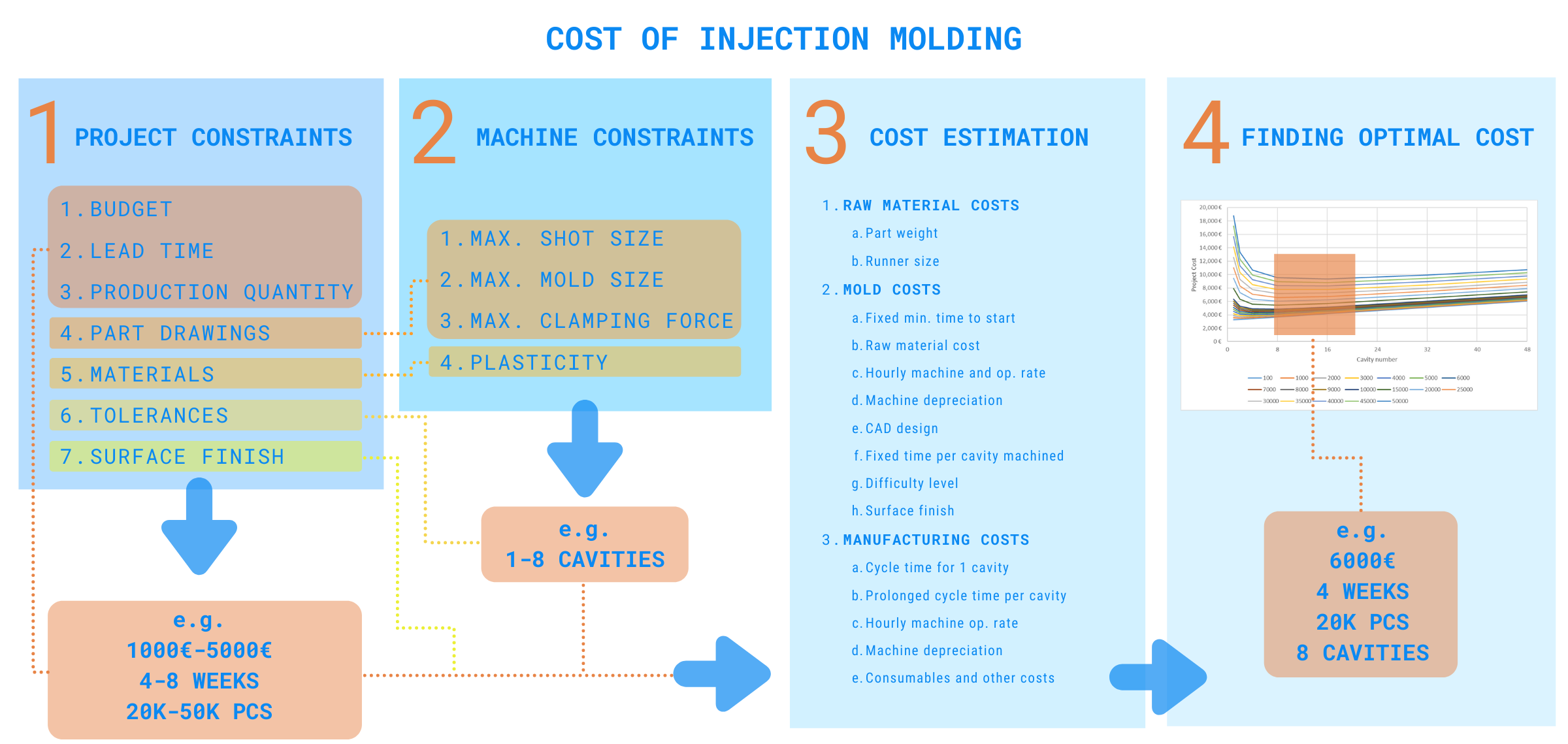
A production injection mold is not a consumable — it is a precision capital asset with a measurable lifespan. Whether your mold is stored at a contract manufacturer in Taiwan or sitting at your own facility, the difference between a tool that delivers 1,000,000 quality shots and one that fails at 350,000 is almost always the maintenance program, not the original tooling quality. This guide covers the financial case for preventive maintenance, the industry-standard PM schedule by shot-count milestone, the five failure points that account for most unplanned downtime, and what documentation to require when a mold enters production at a new facility.
The Financial Case: PM vs. Reactive Maintenance
Consider a $50,000 P20 steel production mold rated for 800,000 shots. A properly managed preventive maintenance program — covering routine cleaning, lubrication, cooling circuit service, and periodic component replacement — costs approximately $2,000–$5,000 per year in labor and materials. Without any PM program, the same mold typically requires $15,000–$30,000 in emergency repairs and early replacement, while delivering only 400,000–500,000 shots before failure. The net tooling cost difference over the rated life is $25,000–$50,000 on a single cavity.
The cost asymmetry between planned and unplanned maintenance is even sharper at the production level. According to ZetarMold’s 2025 facility analysis, unplanned mold stoppages cost 4–8× more per hour than the same repair performed during a scheduled maintenance window — because unplanned events shut down an entire press, disrupt production scheduling, and frequently require emergency part sourcing. Their data shows 78% of unplanned stoppages occurred on molds that had exceeded their recommended PM interval by more than 20%, confirming that deferred maintenance is the primary predictor of unplanned downtime.
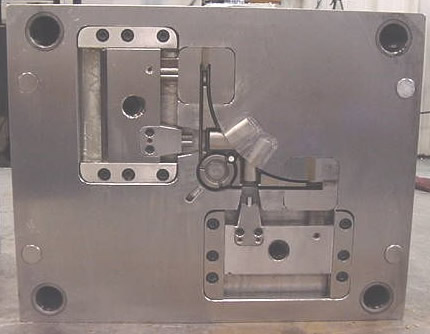
A structured PM program also delivers a measurable quality yield improvement. Daily end-of-shift tasks — cavity inspection, vent check, and ejector function verification — catch approximately 70% of contamination-driven defects before they reach the part surface, according to the same ZetarMold analysis. For OEM programs with tight dimensional tolerances or optical surface requirements, this upstream defect interception is as valuable as the tool life extension itself. A well-maintained mold running preventive maintenance reduces unplanned downtime by 60–80% compared to reactive-only maintenance programs.
The Four-Level PM Schedule: Shot-Count Milestones
The injection molding industry structures mold maintenance around shot-count milestones rather than calendar intervals because actual wear is driven by cycle count and resin type, not elapsed time. A mold running three shifts on a 15-second cycle accumulates shots 12× faster than an identical tool on a single-shift 3-minute cycle — yet both would share identical calendar-based PM dates if scheduled by month. The ZetarMold PM framework and industry maintenance schedule benchmarks converge on four milestone levels:
| PM Level | Trigger | Key Tasks | Typical Duration |
|---|---|---|---|
| Daily / Shift | Every production run | Visual cavity inspection; vent blockage check; ejector function verification; cooling water flow confirmation; parting line residue removal | 5–10 min/shift |
| Level 1 | Every 50,000 shots | Ejector pin diameter measurement; full cavity surface inspection; coolant circuit flow rate test; slide/lifter lubrication; parting line deep-clean | 2–4 hours |
| Level 2 | Every 100,000 shots | All Level 1 tasks; slide and lifter wear measurement; vent depth assessment (recut if >30% blocked); hot runner thermocouple continuity check; water circuit descaling if flow loss detected | 4–8 hours |
| Level 3 | Every 250,000 shots | All Level 2 tasks; mold base alignment verification; guide pillar and bushing inspection; cavity surface polish assessment; hot runner heater resistance check; ejector pin replacement if worn | 1–2 days |
| Level 4 | Every 500,000+ shots | Full cavity/core dimensional survey; hot runner system overhaul and heater band replacement; rebuild decision review; cavity repolish to original specification; alignment pin replacement | 3–5 days |
Tool class affects interval tightness: aluminum prototype tools (5,000–50,000-shot rating) require more frequent surface inspections due to faster wear at high cavity pressures. P20 prehardened steel tools (standard production, 500,000–800,000 shots) follow the schedule above. H13 hardened steel tools (1,000,000–2,000,000+ shots) tolerate slightly extended Level 1 and Level 2 intervals but require the same Level 3 and Level 4 schedules due to the higher consequence of a failure event at high shot counts.
The Five Highest-Risk Failure Points in Any Injection Mold
Most production mold failures trace back to five components. Understanding the warning signs and cost impact of each lets maintenance teams prioritize limited downtime windows and build the business case for PM budget with OEM procurement and program managers.
| Component | Warning Signs | Service Interval | Cost of Neglect |
|---|---|---|---|
| Ejector Pins | Flash on ejector marks; parts sticking in cavity; visible scoring on pin shaft | Replace at >0.05 mm diameter loss or every 50,000 shots on abrasive resins | $5–$50/pin replaced on PM vs. $500–$5,000 for a stuck-part production shutdown |
| Cooling Circuits | >25% flow loss; outlet temperature >5°F above inlet; increasing part warpage or cycle time | Monthly flow rate test; quarterly descaling flush; immediate action at >25% unrecoverable flow loss | 0.5 mm scale buildup reduces heat transfer by up to 30%, extending cycle time and elevating scrap rate on every shift |
| Parting Line | Increasing flash on part edges; visible impact marks; uneven contact pressure | Clean and inspect every shift; use parting line sealant on corrosive or glass-filled resins | $500–$3,000 per welding and re-machining repair event; repeated damage shortens total tool life |
| Hot Runner Heaters & Thermocouples | Gate vestige variation; black specks at gate area; thermocouple signal drift >5% from baseline | Heater band replacement every 6–12 months; thermocouple calibration at every Level 4 PM | Thermocouple failure is the leading cause of gate vestige and black speck defects, requiring full hot runner teardown to diagnose |
| Cavity Surface Corrosion | Pitting or discoloration on cavity wall; surface finish degrading below specification | Apply rust-preventive oil before all storage; use stainless or hard-chrome inserts for PVC and glass-filled resins | Corrosion pitting on a polished optical surface requires full cavity repolish ($1,000–$8,000) or cavity replacement |
Documentation, IATF 16949, and Receiving a Transferred Mold
A preventive maintenance program only delivers its full value when it is documented. ISO 9001:2015 Section 7.1.3 requires organizations to determine, provide, and maintain the infrastructure necessary for process operation — which explicitly includes production tooling maintenance records. For automotive suppliers, IATF 16949:2016 Section 8.5.1.5 goes further, mandating a documented Total Productive Maintenance (TPM) system covering all production equipment and tooling, with records of planned maintenance activities, completed work, and upcoming service triggers.
For OEM procurement and supplier quality teams, TPM documentation is both an audit requirement and a practical risk management tool. A molder who cannot produce a shot-counter log, a maintenance history by PM level, and a current condition report for a specific cavity set is a supplier whose tooling program runs on informal practices — and informal practices are where $30,000 emergency repair events originate.
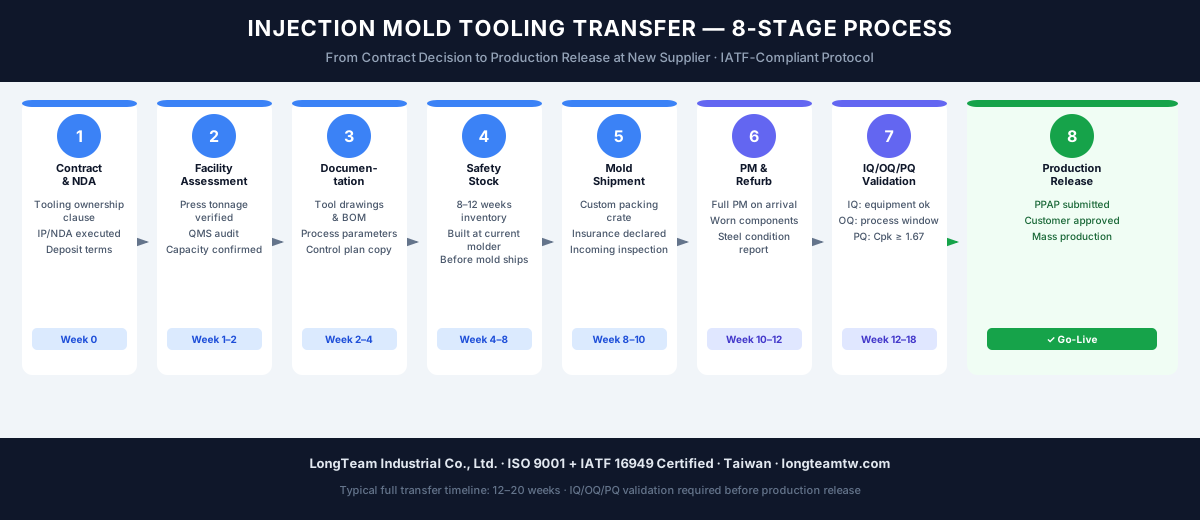
When receiving a mold transferred from another facility, verify four items before authorizing first production:
- Total shot count and maintenance history — request the complete PM logbook; compare actual shot count to the tool’s rated lifespan and confirm all milestone-based PMs were completed on schedule
- Cooling circuit baseline — perform a flow rate test on every circuit against the original qualified baseline; do not release the mold to production if any circuit is more than 25% below specification
- Hot runner electrical baseline — measure heater Ohmic resistance and thermocouple continuity on every zone; resistance drift beyond 5% of the original qualified value indicates aging or moisture-related heater instability that will surface as defects within the first production run
- Cavity surface and ejector function inspection — run a short-shot sequence at reduced injection speed before full production to confirm cavity fill pattern matches the original validated process; check ejector function for sticking or hesitation
These four checks take 4–8 hours at the press. They are the difference between a clean mold transfer and an unplanned stoppage in the first 10,000 shots of production at the new facility — a gap that no amount of expediting can close once a program timeline has slipped.
Need a Tooling Management Partner with Documented PM Records?
LongTeam holds ISO 9001 and IATF 16949 certifications. For programs that require them, tooling records can be scoped to include shot counts, maintenance history, and condition reports. Send the mold history and transfer requirements for an engineering review before production planning.
Discuss Your Tooling Program →What to confirm before supplier review
Use the drawing, material specification, expected demand, application conditions, and acceptance requirements to turn a general process discussion into a program-specific review.
- Which components and defects create the highest production risk?
- What evidence determines maintenance frequency?
- Which spares and specialist support are available?
- How is the mold verified before returning to production?
Continue the engineering review
Use the related guides and capability pages to connect this topic to part geometry, tooling, molding, and qualification decisions.