What matters most
- Confirm legal ownership, release authority, confidentiality, and responsibility for freight and damage.
- Inspect cavities, actions, cooling, hot runner, wear, spares, and open maintenance items.
- Check press, controller, utilities, handling, safety, and material requirements at the receiving site.
Establish the transfer baseline before moving the tool
Evaluate the technical choice together with part requirements, tooling consequences, production controls, and the evidence required for approval.
Ownership
Confirm legal ownership, release authority, confidentiality, and responsibility for freight and damage.
Tool condition
Inspect cavities, actions, cooling, hot runner, wear, spares, and open maintenance items.
Compatibility
Check press, controller, utilities, handling, safety, and material requirements at the receiving site.
Requalification
Agree on trial conditions, samples, dimensions, appearance, capability, and customer approvals.
Technical guide
The sections below retain the detailed design, tooling, process, and quality context needed to evaluate this topic beyond the summary.
Key Takeaways
- 1 Supply chain restructuring is accelerating mold transfers: the global injection molding machines market is projected to grow from US$8.26 billion in 2025 to US$14.28 billion by 2035, driven by “China Plus One” sourcing strategies and 25% US tariffs on Chinese-origin manufacturing.
- 2 Documentation is the #1 bottleneck in every transfer: OEMs who compile 3D files, maintenance records, process parameters, and golden samples before shipping the tool cut qualification time by weeks and eliminate the most common causes of T1 failure at the receiving facility.
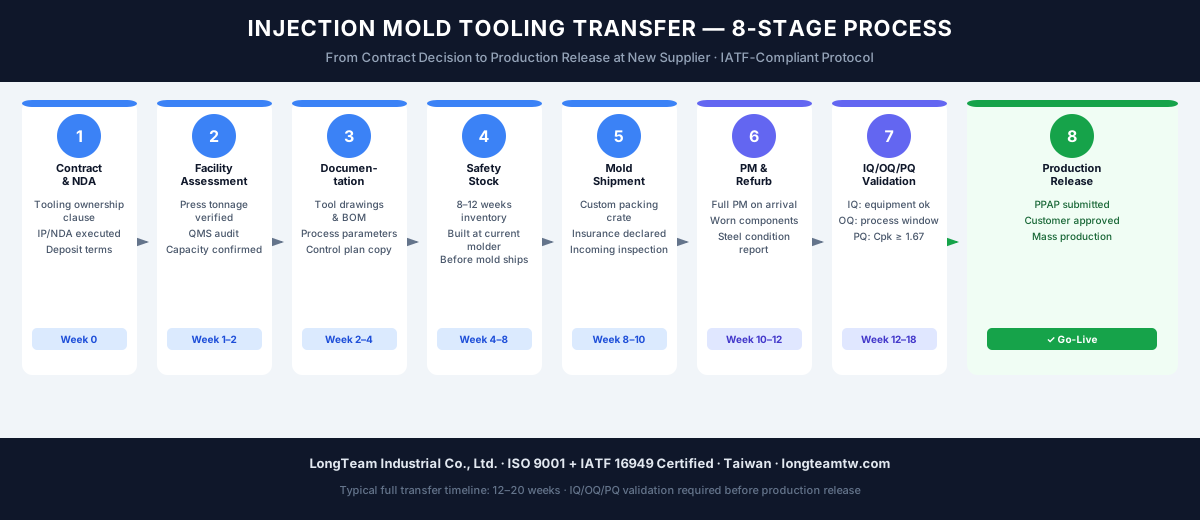
- 3 A standard transfer runs 8 phases from contract through production; plan for at least 6 weeks of safety stock to buffer inventory during the validation window and avoid line-down risk while qualification is underway.
- 4 IQ/OQ/PQ qualification — the three-step framework used by medical and automotive OEMs — is the industry standard for confirming a new facility can hold your critical dimensions at production rate; Performance Qualification (PQ) is the phase most commonly under-resourced by receiving suppliers.
Why OEMs Are Moving Molds in 2025 — and Why the Process Matters
The injection mold tooling transfer has gone from an edge-case event to a routine procurement operation. A confluence of forces — 25% US tariffs on Chinese-manufactured goods, the “China Plus One” supply chain restructuring strategy, and growing demand for supply-chain resilience — is driving OEM procurement teams to relocate tooling at a pace not seen in two decades. According to Astute Analytica’s 2025 injection molding machines report, the global market is forecast to reach US$14.28 billion by 2035, up from US$8.26 billion in 2025 — growth driven in significant part by capacity additions outside China as OEMs diversify their tooling base.
Taiwan sits at the center of this shift. As the Dallas Federal Reserve noted in 2025, Taiwan manufacturers were among the first to begin diversification out of China in the 2010s and are now well-positioned to receive molds transferred from Chinese facilities — with the precision machining infrastructure, English-language engineering communication, and ISO/IATF certification structure that OEM procurement teams require. The challenge is not the decision to transfer — it is executing the transfer without a production gap, without losing the institutional process knowledge embedded in the existing tool, and without spending more on qualification than the transfer saves in supply chain risk reduction.
This guide walks through the eight-stage process a rigorous mold transfer follows, the documentation every OEM should compile before shipping the tool, and the IQ/OQ/PQ qualification framework used by medical and automotive programs to confirm the new facility can deliver parts to print at production rate.
Pre-Transfer Documentation: The Checklist That Prevents T1 Failures
The single most reliable predictor of a smooth mold transfer is the completeness of the documentation package that travels with the tool. Per the Ferriot mold transfer framework and Spaulding’s eight-stage transfer process, the following items must accompany the mold or be transmitted digitally before the tool ships:
- 3D and 2D files — STEP/IGS mold design files, plus 2D part drawings with all GD&T callouts and critical dimension flags
- Process parameter sheet — documented barrel temperatures, injection speed profiles, hold pressure, cooling time, and mold temperature from the last validated production run at the outgoing supplier
- Dimensional measurement reports — the last first-article inspection (FAI) or CMM report, with data for all critical and major dimensions
- Maintenance history — a log of all repairs, steel additions, insert replacements, and preventive maintenance cycles, including dates and shot counts
- Golden samples — at least 5 parts from the last qualified production run, clearly labeled with date and lot number
- Resin specification — material grade, supplier, and lot traceability from the last run, including dried material parameters
- Quality records — any open non-conformances, CAPA reports, or known cosmetic issues with root-cause notes
- Mold ownership documentation — written confirmation that the OEM holds title to the tooling, signed by the outgoing supplier
Missing any item — particularly the process parameter sheet or golden samples — forces the receiving facility to reconstruct the validated process from first principles, typically adding 2–4 weeks to the qualification timeline and significantly increasing the risk of a T1 failure on the first trial shot.
The 8-Stage Transfer Process: Timeline and Deliverables
A structured mold transfer follows eight sequential phases, as documented by Spaulding Company and Crescent Industrial. The table below maps each phase to its typical duration, primary deliverable, and the party responsible for driving it forward:
| Phase | Typical Duration | Primary Deliverable | Driven By |
|---|---|---|---|
| 1. Contractual Agreement | 1–2 weeks | Signed NDA, mold ownership clause, SLA terms, quality acceptance criteria | OEM + new supplier |
| 2. Facility & Capability Assessment | 3–7 days | On-site audit confirming press tonnage compatibility, CMM capability, and resin handling | OEM quality engineer |
| 3. Documentation Package Assembly | 1–3 weeks | Complete transfer kit: 3D files, process params, CMM reports, maintenance log, golden samples | OEM + outgoing supplier |
| 4. Safety Stock Build | Concurrent / ~6 weeks | Approved production inventory buffer against line-down risk during qualification window | OEM planning |
| 5. Tool Shipment & Receipt Inspection | 1–2 weeks | Photographic damage report, steel certification review, cavity & core cleaning | New supplier tooling team |
| 6. Mold Evaluation & Preventive Maintenance | 1–2 weeks | Wear assessment report, PM completion record, any pre-qualification repairs documented | New supplier tooling team |
| 7. Validation (T1 trial + IQ/OQ/PQ) | 2–6 weeks | CMM dimensional report, Cpk data, FAI package, OEM approval sign-off | New supplier QE + OEM |
| 8. Production Molding | Per schedule | Approved first production lot shipped to OEM | New supplier |
Total elapsed time from contract signing to first approved production lot typically runs 8–14 weeks for a well-documented, single-cavity steel mold at a prepared receiving facility. Complex multi-cavity or family molds requiring significant preventive maintenance — or programs where the documentation package is incomplete — routinely extend the timeline by 4–8 additional weeks.
IQ/OQ/PQ Qualification: What the Three Phases Actually Require
IQ/OQ/PQ is the FDA-aligned, ISO 13485–compatible qualification protocol used by medical device and automotive OEMs to confirm that a new facility can run their part to specification. As described by Kaysun Corporation and Aprios, each phase generates distinct documentation and distinct evidence of process readiness:
| Phase | Full Name | What It Confirms | Key Evidence Required |
|---|---|---|---|
| IQ | Installation Qualification | Mold, press, and auxiliaries are installed and connected per design specifications | Equipment calibration records, utility connection verification, safety system checks |
| OQ | Operational Qualification | Process produces conforming parts across the full approved process window (high/low/nominal) | Design of Experiments (DOE) data, process window documentation, dimensional reports at each parameter extreme |
| PQ | Performance Qualification | Process is stable and repeatable under normal production conditions with approved production-grade material | Cpk ≥ 1.33 for all critical dimensions, Gage R&R study, lot-to-lot material traceability, 3 consecutive conforming production lots |
For non-regulated industries (consumer electronics, industrial equipment), a full IQ/OQ/PQ is often replaced by a first-article inspection (FAI) and a Cpk study on critical dimensions — but the underlying logic is the same: the receiving facility must prove process capability before taking over production. The FDA’s updated Quality Management System Regulation (QMSR) now aligns US medical device expectations closely with ISO 13485:2016, meaning Cpk targets and documentation requirements apply equally to mold transfers as to new mold qualifications.
The PQ phase — requiring three consecutive conforming production lots with full statistical analysis — generates the bulk of validation expense due to engineering time, material consumption, and CMM measurement costs. OEMs who negotiate PQ scope and acceptance criteria into the transfer contract upfront, rather than discovering them mid-qualification, avoid the most common source of cost overrun in mold transfers to a new supplier.
Transferring a Mold to LongTeam? Here Is Exactly What Happens Next.
LongTeam Industrial reviews tooling transfers from China-based suppliers and other Taiwan facilities through its integrated tooling and molding operation. Send the available mold documentation so the team can confirm inspection needs, trial stages, engineering ownership, deliverables, and timing before a transfer quotation is prepared.
Start Your Transfer Assessment →What to confirm before supplier review
Use the drawing, material specification, expected demand, application conditions, and acceptance requirements to turn a general process discussion into a program-specific review.
- Is the complete tool and document package available?
- What is the last approved sample and process baseline?
- Which repairs are required before or after transfer?
- What evidence authorizes production at the new site?
Continue the engineering review
Use the related guides and capability pages to connect this topic to part geometry, tooling, molding, and qualification decisions.