What matters most
- Specify film or label construction, ink, coatings, thickness, forming, storage, orientation, and approved supplier.
- Confirm grade-level adhesion, temperature exposure, shrinkage, color, opacity, and environmental durability.
- Review nests, registration, static or vacuum retention, gates, vents, sensors, automation, and contamination.
Treat decoration as a controlled molded component
Evaluate the technical choice together with part requirements, tooling consequences, production controls, and the evidence required for approval.
Decoration
Specify film or label construction, ink, coatings, thickness, forming, storage, orientation, and approved supplier.
Compatibility
Confirm grade-level adhesion, temperature exposure, shrinkage, color, opacity, and environmental durability.
Tool and handling
Review nests, registration, static or vacuum retention, gates, vents, sensors, automation, and contamination.
Appearance
Define alignment, wrinkles, bubbles, edge condition, distortion, gloss, color, and inspection lighting.
Technical guide
The sections below retain the detailed design, tooling, process, and quality context needed to evaluate this topic beyond the summary.
Key Takeaways
- 1 IML integrates label application into the injection molding cycle — eliminating pad printing, painting, and heat-transfer steps that add $0.03–$0.08 per part in secondary decoration cost.
- 2 IML-decorated parts achieve 10+ year label durability versus 2–5 years for pad printing — critical for outdoor, dishwasher-safe, and chemical-contact applications.
- 3 Mold tooling cost increases 25–40% for IML — but per-part decoration drops to $0.01–$0.04 at volume, making programs above 50,000 units per run economically positive.
- 4 Over 70% of global IML production runs on polypropylene (PP); ABS and PC require specialized film formulations and tighter process windows.
For product engineers and procurement managers specifying decorated plastic parts, secondary operations — pad printing, painting, heat-transfer labeling — are a persistent source of lead-time risk, adhesion failures, and unit-cost creep. In-mold labeling (IML) and in-mold decoration (IMD) shift the entire decoration step inside the injection molding cycle, producing a finished, decorated part in a single machine operation. This guide explains how both processes work, what they require from the mold, and how to evaluate whether the economics make sense for your program.
What Are IML and IMD? Process Overview and Key Differences
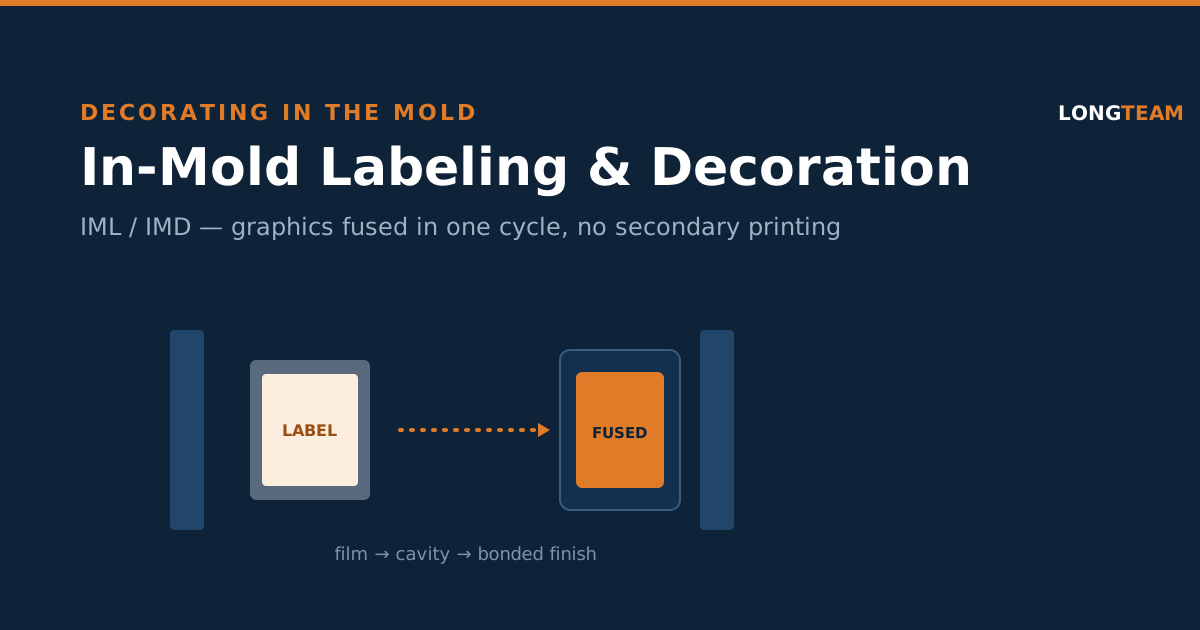
In-mold labeling (IML) uses a pre-printed polymer film — typically polypropylene — die-cut to cavity dimensions with tolerances of ±0.15 mm. A robot places this film against the cavity wall before the mold closes; the injected plastic bonds chemically with the film’s tie layer during the molding cycle, producing a part with the label permanently fused to its surface rather than adhered on top of it.
In-mold decoration (IMD) is a broader category that also includes film-insert molding (FIM) and in-mold film (IMF), where a continuous printed film is indexed through the open mold between shots. IMD is typically used for flat-to-mildly-curved surfaces such as control panels, appliance fascias, and automotive trim, where roll-to-roll film handling is practical. IML, by contrast, handles fully three-dimensional geometries — buckets, containers, housings — where individual pre-cut labels must be robotically inserted.
According to Mordor Intelligence, the global IML market was valued at USD 2.42 billion in 2024 and is projected to reach USD 3.46 billion by 2032 at a CAGR of 4.6%. Injection molding accounts for 57.23% of the IML market by production process. Asia-Pacific holds over 40% market share, driven by food & beverage packaging, consumer goods, and automotive trim — all sectors that regularly source tooling from contract molders in Taiwan.
Mold Design for IML: Four Changes Inside the Tool
IML is not a retrofit process — it requires deliberate design decisions at the tooling stage. The four critical modifications versus a standard injection mold are detailed below.
1. Vacuum channels behind cavity surfaces. Most IML molds use 0.3–0.5 mm diameter vacuum channels to hold the film flat against the cavity wall during mold closure and initial injection. These channels must be sized carefully: too large and they leave witness marks on the part surface; too small and film positioning becomes inconsistent across cavities.
2. Electrostatic charging as an alternative to vacuum. As documented by Plastics Technology, electrostatic gripper systems on the label-insertion robot can hold labels to cavity walls without vacuum ports at all — eliminating port-drilling cost and maintenance while providing uniform adhesion on complex 3D geometry. This approach is particularly effective for deep-draw containers where vacuum uniformity is difficult to maintain.
3. Gate repositioning. The injection gate must be located away from the label zone to prevent the melt front from displacing or creasing the film during fill. This often means repositioning the gate from the base or side of a container to a non-labeled area — a constraint that must be resolved in DFM review before steel is cut, not after.
4. Ejection routing through the non-labeled face. Ejector pins routed through the label surface leave stress marks and risk delaminating the film bond. All ejection must act on the non-decorated face of the part, which may require additional ejector locations to ensure balanced, mark-free release at speed.
IML vs. Pad Printing vs. Painting: Cost and Performance at a Glance
The data below is based on industry benchmarks from ZetarMold’s IML process documentation and reported OEM comparison studies. Figures assume a mid-size PP consumer goods part, approximately 500 g shot weight.
| Factor | Pad Printing | Spray Painting | In-Mold Labeling (IML) |
|---|---|---|---|
| Per-part decoration cost | $0.03–$0.08 | $0.05–$0.15 | $0.01–$0.04 at volume |
| Label / graphic durability | 2–5 years | 3–7 years (with clear coat) | 10+ years (subsurface bond) |
| Secondary operation required | Yes — separate station | Yes — spray booth + cure | No — in-cycle |
| Cycle time impact | Separate operation added | Separate operation + dry time | +2–4 sec per shot (label insert) |
| Color and image complexity | 1–4 colors typical | Solid colors, limited gradients | Full photographic quality (CMYK) |
| Dishwasher / chemical resistance | Limited | Moderate with clear coat | Excellent — label is subsurface |
| Tooling cost premium vs. standard mold | Pad + artwork setup only | Masking tooling + booth | +25–40% on mold cost |
IML’s mold cost premium is a one-time capital expense; the per-part decoration savings accumulate with every shot. For food-contact and personal care applications, IML also eliminates the VOC exposure associated with spray painting — an increasing compliance concern under EU and US environmental frameworks.
When to Specify IML: Breakeven Logic and Program Fit
IML makes economic sense when three conditions align simultaneously: (1) annual volumes exceed 50,000–100,000 units per decoration variant per production run; (2) the part geometry is three-dimensional or requires decoration on a curved surface where applied labels would wrinkle or peel; and (3) decoration durability or adhesion is a functional product requirement, not merely a cosmetic preference.
Over 70% of global IML production runs on polypropylene according to industry process benchmarks, because PP’s semi-crystalline structure and processing temperature of 200–240°C ensures reliable chemical bonding with standard PP-based label films — at a film cost of just $0.005–$0.015 per label. ABS and polystyrene require specialized tie-layer formulations; polycarbonate’s high processing temperature (280–320°C) can degrade standard films, requiring specialty stock that costs 2–3× more per label.
Programs that are not a good fit for IML include: low-volume NPI parts (under 10,000 units per run), parts where decoration artwork changes frequently between production runs, and parts with extreme draft angles that prevent consistent label seating in the cavity. For these cases, pad printing or heat-transfer labeling applied post-mold remains the more flexible, lower-tooling-cost approach.
The correct time to design for IML is at the DFM stage — before the mold is designed. Retroactively modifying a standard mold to accept IML labels typically costs 60–80% of the price of a new IML-ready mold from scratch, because gate position, ejector layout, and vacuum or electrostatic routing all require simultaneous revision.
Evaluating IML or IMD for Your Next Program?
LongTeam’s engineering team reviews decoration requirements at the DFM stage — before tooling is committed — to ensure gate position, ejection routing, and vacuum or electrostatic design are optimized for IML from the start. Contact us to discuss your decorated-part program.
Discuss Your IML ProgramWhat to confirm before supplier review
Use the drawing, material specification, expected demand, application conditions, and acceptance requirements to turn a general process discussion into a program-specific review.
- Is the application IML, IMD, or another decoration process?
- Who supplies and approves the film or label?
- How is placement detected before injection?
- Which cosmetic and durability tests approve the finished part?
Continue the engineering review
Use the related guides and capability pages to connect this topic to part geometry, tooling, molding, and qualification decisions.