What matters most
- Identify thick sections, gas channels, transitions, flow leaders, penetrations, and areas that must remain solid.
- Review surface, gloss, read-through, hesitation, fingering, and gate or needle marks.
- Define resin fill, gas timing, pressure control, venting, purging, and safe operation.
Confirm that the gas path supports the part requirement
Evaluate the technical choice together with part requirements, tooling consequences, production controls, and the evidence required for approval.
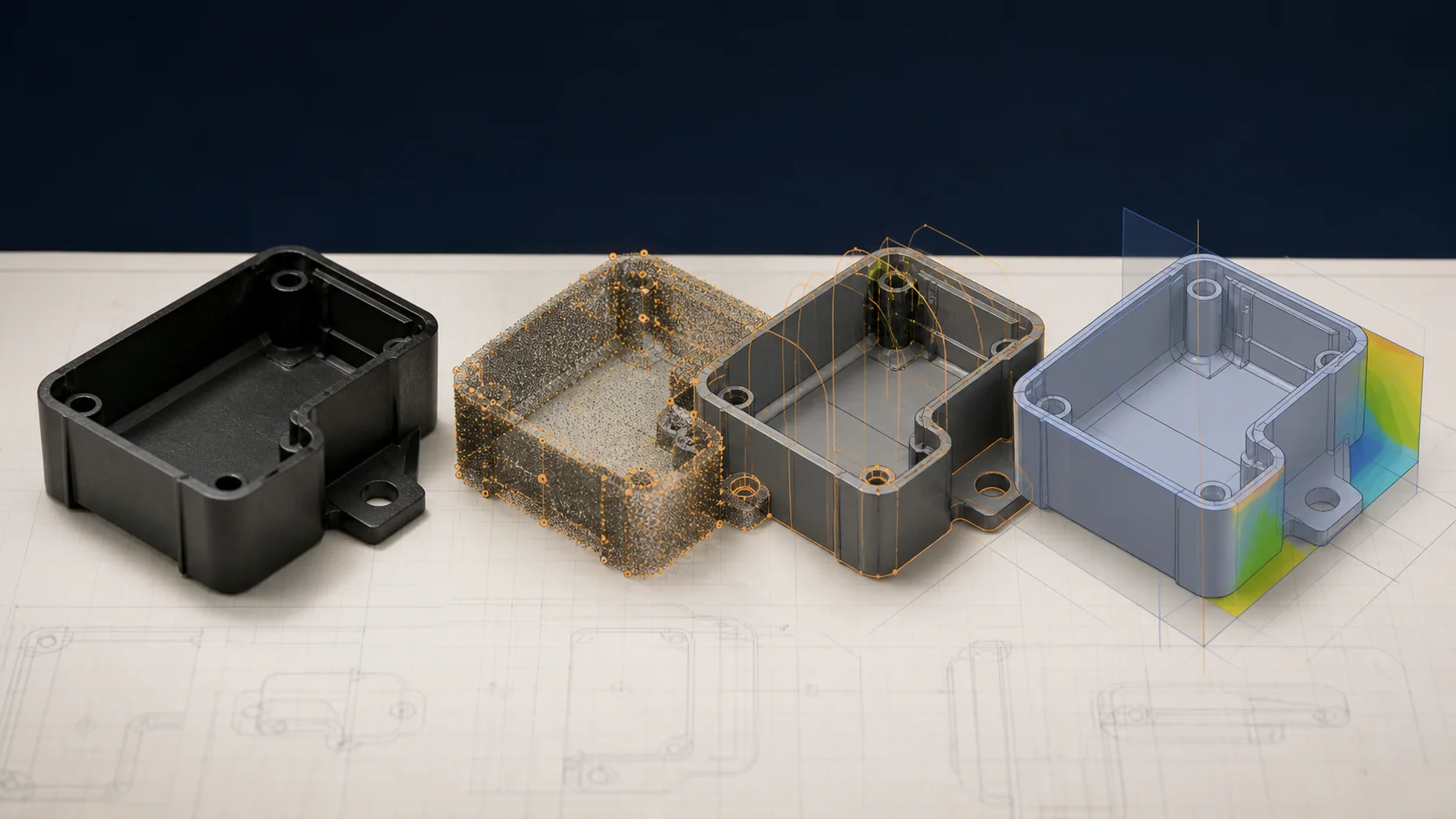
Geometry
Identify thick sections, gas channels, transitions, flow leaders, penetrations, and areas that must remain solid.
Appearance
Review surface, gloss, read-through, hesitation, fingering, and gate or needle marks.
Process
Define resin fill, gas timing, pressure control, venting, purging, and safe operation.
Validation
Use sectioning, weight, dimensions, appearance, strength, and functional tests to approve the internal result.
Technical guide
The sections below retain the detailed design, tooling, process, and quality context needed to evaluate this topic beyond the summary.
Key Takeaways
- 1 GAIM injects nitrogen into a partially filled mold, displacing the core and creating hollow internal channels — reducing resin consumption by 20–40% per part.
- 2 Hollow gas channels cool faster than solid thick walls, cutting cycle time by 10–30% and virtually eliminating sink marks on thick bosses and structural ribs.
- 3 Nitrogen (2,000–4,500 psi) is injected once the cavity is 70–90% filled; the gas follows the hottest, least-viscous material path to form uniform hollow cores.
- 4 GAIM becomes ROI-positive when part weight exceeds ~200 g and annual volumes top 20,000 units — material savings typically recover the tooling premium within the first production year.
Thick-wall plastic parts are injection molding’s most expensive problem. Solid cores require extended cooling cycles, create sink marks on cosmetic surfaces, add unnecessary weight, and waste resin on material that contributes nothing to structural performance. Gas-assisted injection molding (GAIM) solves all four by hollowing out those cores with pressurized nitrogen during the molding cycle itself — before the part ever leaves the mold.
This process guide explains how GAIM works at a mechanical level, the design rules that govern it, which materials perform best, and how to evaluate whether it makes economic sense for your program.
How Gas-Assisted Injection Molding Works
GAIM is a two-stage process. In stage one, the injection machine fills approximately 70–90% of the mold cavity with molten resin — a deliberate short shot, not a full fill. The outer layer of plastic immediately begins solidifying against the cooler mold wall, forming a rigid skin. In stage two, pressurized nitrogen gas is injected through a dedicated gas pin or through the sprue, typically at 2,000–4,500 psi depending on polymer viscosity and wall thickness. The gas follows the path of least resistance: straight through the hottest, least-viscous plastic still liquid in the core, creating a hollow channel as it displaces material toward the mold walls and advancing flow front.
Gas hold pressure is maintained for 5–10 seconds while the part cools, compensating for polymer shrinkage from inside the part rather than from the gate. Once the part has solidified, the gas vents, and the part ejects normally — appearing externally identical to a conventionally molded part, but with hollow internal channels that account for 10–30% of the total volume.

There are two GAIM variants. Internal gas injection — the standard approach — introduces gas through the sprue or a dedicated gas pin directly into the part cavity. External gas injection applies gas pressure to the non-cosmetic surface of the part from outside the cavity wall, packing the cosmetic face against the mold surface to achieve sink-free Class A finish. External GAIM is used when internal channels would compromise structural integrity or when cosmetic requirements on one face are extremely tight.
GAIM vs. Standard Injection Molding: When the Process Pays Off
Gas assist is not a universal upgrade — it solves specific problems that conventional molding cannot address cost-effectively. The table below compares the two processes across the criteria that matter most for program decisions:
| Criterion | Standard Injection Molding | Gas-Assisted (GAIM) |
|---|---|---|
| Material usage | Full solid fill | 20–40% reduction via hollow channels |
| Cycle time | Baseline | 10–30% faster on thick-wall parts |
| Sink marks on thick walls | High risk without design compromises | Virtually eliminated by internal gas pressure |
| Effective wall thickness | 4–6 mm practical max without cycle penalty | Thick sections up to 25 mm with hollow cores |
| Clamp force | Full cavity pressure required | Lower — partial fill reduces projected-area pressure |
| Tooling complexity | Standard | Gas pins, overflow wells, and venting required |
| Tooling cost premium | Baseline | +$8,000–$25,000 depending on complexity |
| Best for | Thin-wall, multi-cavity, high-cosmetic parts | Structural parts >200 g, hollow handles, automotive interior |
Classic GAIM applications include automotive door handles, interior grab rails, dashboard structural carriers, appliance handles, furniture frames, and pipe fittings — any part where a conventional solid section would be over-engineered, heavy, slow to cycle, and cosmetically difficult to produce. The automotive sector relies on GAIM precisely because lighter plastic interior components reduce vehicle weight without compromising the rigidity required for crash-tested door and pillar systems.
Design Rules for Gas-Assisted Injection Molding
Designing for gas assist is fundamentally different from designing for solid injection molding. Fictiv’s GAIM design guide and the Society of Plastics Engineers’ ten-rule framework align on the following requirements:
- › Gas channel diameter: 4–12 mm for medium-sized parts; 2–4 mm for small parts; 8–16 mm for large structural sections. Undersized channels result in incomplete hollow formation; oversized channels cause blow-through into the part face.
- › Channel-to-wall thickness ratio: The gas channel cross-section must be 2:1 to 4:1 relative to the nominal wall. If the surrounding wall is 3 mm, the channel should be 6–12 mm. Ratios below 2:1 create premature channel solidification before gas can penetrate.
- › No sharp corners adjacent to gas paths: Sharp 90° transitions cause blow-through as the gas follows the corner geometry rather than the intended channel path. Radius all corners along gas paths at ≥2× nominal wall thickness.
- › Gas pin placement: Position pins adjacent to the thickest sections or at the distal end of long ribs — wherever the gas needs to penetrate deepest. Entry near the thickest wall maximizes penetration depth and channel consistency.
- › Avoid multi-cavity arrangements with size variation: Gas distributes unevenly across cavities of different volume, making consistent hollow formation unreliable. GAIM performs best in single-cavity or matched-size family molds.
Material Compatibility and Tooling Economics
Not all polymers perform equally in gas assist. High melt stiffness is the key property — the solidified skin must hold its shape while the gas displaces the core. GAIM material suitability by polymer type:
| Material | GAIM Suitability | Notes |
|---|---|---|
| ABS | Excellent | High melt stiffness; widely used for automotive interior handles and panels |
| PC / PC-ABS | Excellent | High melt strength; ideal for structural handles and enclosures requiring impact resistance |
| PP (Polypropylene) | Good | Most common GAIM resin by volume; lower stiffness requires tighter gas timing control |
| PA6 / PA66 (Nylon) | Good | Effective for structural components; moisture content must be controlled pre-process |
| HDPE / LDPE | Limited | Low melt stiffness causes gas channeling instability; difficult to control consistently |
| Clear / Transparent resins | Not recommended | Internal gas channels create visible boundaries that degrade optical clarity |
The tooling cost decision for GAIM follows a clear ROI logic. Gas injection systems, overflow wells, and specialized gas pins typically add $8,000–$25,000 to a conventional mold’s base cost. Against this, count the ongoing savings: 20–40% material reduction on every part shot, 10–30% cycle time reduction, and elimination of secondary operations for sink mark remediation. On a program running 50,000 parts per year with a 250 g PP part saving 30% resin, the material cost reduction alone typically recovers the tooling premium within the first production year at standard PP resin pricing.
The practical break-even threshold: parts heavier than 150–200 g, annual volumes above 20,000 units, and a geometry that already has thick sections causing sink marks or extended cooling cycles in standard molding. Below that threshold, optimizing wall thickness in conventional molding is usually more economical than adding gas assist infrastructure.
Evaluate GAIM for Your Program
LongTeam’s engineering team reviews GAIM feasibility as part of the DFM process — assessing whether your part geometry, material, and volume profile make gas assist ROI-positive before any tooling commitment. Founded in 1989, LongTeam reviews advanced-process molding programs against the customer’s application, quality, and documentation requirements.
Request a GAIM Feasibility Review →What to confirm before supplier review
Use the drawing, material specification, expected demand, application conditions, and acceptance requirements to turn a general process discussion into a program-specific review.
- What functional reason justifies gas assistance?
- Where should gas travel and where must it not enter?
- Which equipment and process-development experience are available?
- How will internal hollow sections be inspected and approved?
Continue the engineering review
Use the related guides and capability pages to connect this topic to part geometry, tooling, molding, and qualification decisions.