What matters most
- Define whether the program targets recycled content, carbon reporting, restricted substances, mass reduction, durability, or recyclability.
- Approve the exact grade, source, variability limits, color, additives, and substitution rules.
- Review drying, contamination, filtration, degradation, appearance, and process-window effects.
Make sustainability requirements measurable
Evaluate the technical choice together with part requirements, tooling consequences, production controls, and the evidence required for approval.
Objective
Define whether the program targets recycled content, carbon reporting, restricted substances, mass reduction, durability, or recyclability.
Material
Approve the exact grade, source, variability limits, color, additives, and substitution rules.
Production
Review drying, contamination, filtration, degradation, appearance, and process-window effects.
Evidence
Specify declarations, chain-of-custody records, test data, and change notifications.
Technical guide
The sections below retain the detailed design, tooling, process, and quality context needed to evaluate this topic beyond the summary.
Key Takeaways
- 1 The EU Packaging and Packaging Waste Regulation (PPWR), in force since February 2025, sets legally binding recycled-content minimums — making PCR material qualification a compliance requirement, not a branding choice.
- 2 PCR PP and PCR ABS are the most production-ready recycled resins; PLA suits lower-temperature applications; PHA is the most versatile bio-based option but commands a 3×–5× cost premium over virgin resin.
- 3 Recycled resins exhibit Melt Flow Index (MFI) variability of ±24% or more, requiring wider process windows, potentially adjusted gate geometry, and lot-by-lot incoming QC — standard practice in an IATF 16949-certified facility.
- 4 Switching from virgin to recycled resin reduces energy consumption by up to 70% and CO₂ emissions by up to 75% — a compelling Scope 3 carbon accounting story for OEM sustainability reports.
The Compliance Landscape: Why Sustainability Is Now a Procurement Requirement
For much of the past decade, “sustainable sourcing” was a brand-differentiation strategy. In 2025, it became a compliance requirement. The EU Packaging and Packaging Waste Regulation (PPWR) entered into force on February 11, 2025, with key provisions applying from August 2026. It sets legally binding minimum recycled content targets — PET beverage bottles must already contain at least 25% recycled plastic, rising to 30% by 2030. Broader plastics categories face similar mandates phasing in through the decade.
OEM procurement teams are feeling pressure from both directions. Automotive giants like Stellantis have announced targets to use 40% recycled content in vehicle plastics by 2030, and are folding those targets into tier-1 and tier-2 supplier contracts now. Meanwhile, surveys show that 90% of buyers prefer brands with demonstrably eco-friendly supply chains — a figure that translates directly into sourcing decisions for consumer electronics, appliance, and medical device manufacturers.
Starting in mid-2025, EU manufacturers must also embed detailed material data — polymer types, additives, recycled content percentages, and end-of-life instructions — into mandatory Digital Product Passports. For OEMs sourcing from Taiwan or other offshore locations, this means suppliers must provide documented material traceability, not just a quality certificate. The question is no longer whether to specify recycled content, but how to do it without compromising part performance or mold program timelines.
Material Options: PCR, PIR, and Bio-Based Resins Compared
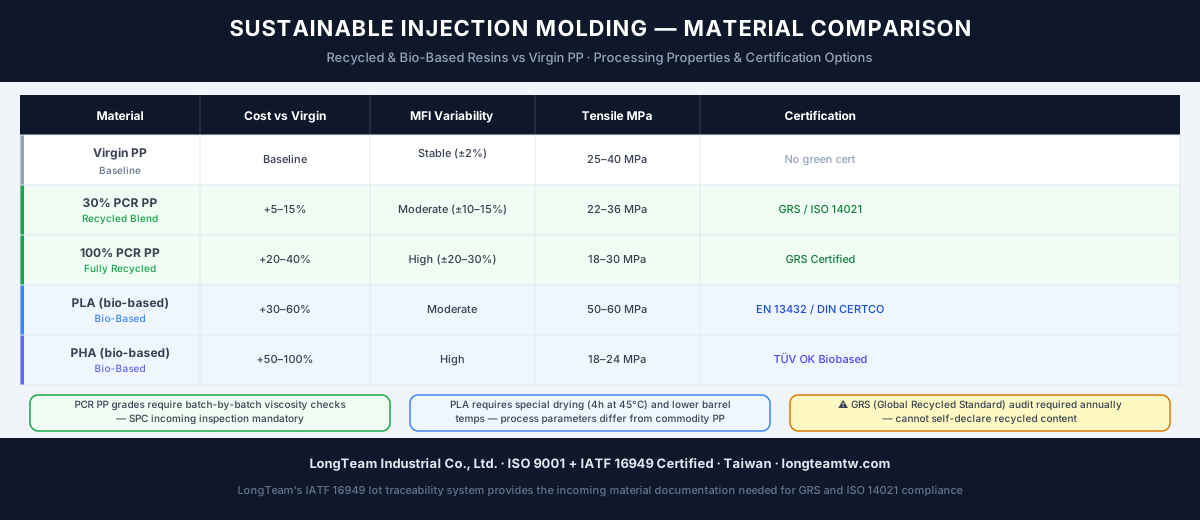
Sustainable injection molding materials fall into two families: mechanically recycled resins (post-consumer recycled/PCR and post-industrial recycled/PIR) and bio-based polymers (PLA, PHA, and bio-attributed variants of conventional resins). Each has a distinct maturity level, cost profile, and performance envelope. The table below summarizes the parameters an OEM engineering team should evaluate during material selection.
| Material | Type | Cost vs. Virgin | MFI Variability | Heat Deflection | Best Application Fit |
|---|---|---|---|---|---|
| PCR PP | Recycled | 0.85–1.1× | ±24% | 100–115°C | Enclosures, brackets, consumer goods |
| PCR ABS | Recycled | 1.0–1.3× | ±15–20% | 88–100°C | Appliances, electronics housings |
| PIR PP | Recycled | 0.75–0.95× | ±10–15% | 100–120°C | Industrial parts, automotive non-visible |
| PLA | Bio-based | 1.5–2.5× | Low (<±5%) | 45–60°C | Packaging, low-temp consumer goods |
| PHA | Bio-based | 3.0–5.0× | Moderate (±10%) | 90–130°C (grade-dependent) | Medical, marine, premium biodegradable |
PCR polypropylene is the most cost-competitive entry point. Industry adoption of PCR resins is growing at approximately 7.5% per year, and for non-visible structural parts with modest cosmetic requirements, PCR PP can approach price parity with virgin material as recycled supply chains mature. PCR ABS is well-established in appliance and consumer-electronics programs; Rosti has validated a 95% PCR PP formulation now in mass production for a leading appliance OEM, demonstrating that high recycled-content parts are achievable at production volumes.
Bio-based options demand more engineering caution. PLA has a heat deflection temperature of only 45–60°C unmodified and demands strict moisture control in processing (≤50 ppm) to prevent hydrolytic degradation. PHA is more mechanically versatile and fully biodegradable in marine and soil environments, but at 3×–5× the cost of virgin resin it is reserved for premium applications or regulatory mandates. Global bioplastics production capacity is forecast to nearly double from 2.31 million tonnes in 2025 to 4.69 million tonnes by 2030, which should gradually reduce the bio-based cost premium.
Processing Challenges: What Recycled Resins Mean for Mold Design
The single biggest technical challenge in switching to recycled resins is viscosity variability. Unlike virgin resin manufactured to a consistent Melt Flow Index, PCR material inherits the processing history of whatever products it was recycled from. Research published in Plastics Technology shows that recycled polypropylene MFI can vary by ±24% from lot to lot — a 20 MFI-rated material arriving anywhere between 15 and 25 MFI in practice. In extreme cases, PCR batches have shown MFI swings from 30 to 70 within the same nominal material grade.
For injection mold programs, this variability has several practical implications:
- Gate sizing: Gates designed for a specific virgin resin MFI may need to be widened 10–20% to accommodate lower-MFI PCR lots without short-shots or excessive fill pressure.
- Process windows: Barrel temperature profiles, injection speed ramps, and hold pressure require broader dynamic ranges; plan for real-time parameter adjustments between batches.
- Mold steel specification: Higher fill pressures from low-MFI lots place additional fatigue load on mold steel. For high-volume PCR programs, upgrading from P20 to H13 steel in critical cores and cavity inserts is a worthwhile investment.
- Incoming QC: Systematic MFI testing of each PCR lot before production — standard practice under IATF 16949 — enables process adjustments before material enters the press rather than during troubleshooting.
PIR resins, sourced from manufacturing scrap rather than post-consumer waste streams, exhibit significantly less variability (±10–15% MFI) and are often the preferred starting point for programs where tight dimensional tolerances are non-negotiable. Research presented at ANTEC 2025 has demonstrated methods to modify PIR-PP melt flow rates to match conventional injection molding process parameters, further narrowing the performance gap with virgin resin.
Evaluating Your Supplier’s Sustainability Credentials
Sustainability credentials from an injection molding supplier divide into three layers: material traceability, process energy efficiency, and quality system certification. Each layer matters for different reasons in an OEM audit or supplier questionnaire.
Material traceability means the supplier can provide documented chain-of-custody for every resin lot — specifying recycled content percentage, source stream (PCR vs. PIR), and the recycler’s certification (ISCC+, GRS, or USDA BioPreferred for bio-based content). Without this documentation, OEMs cannot populate Digital Product Passports or substantiate recycled content claims to EU regulatory bodies.
Process energy efficiency is evaluated through machine technology. All-electric and hybrid injection molding machines consume 30–70% less energy than equivalent hydraulic presses, and modern machines with energy monitoring systems generate the per-part energy data that feeds Scope 3 carbon accounting. This benefit compounds when combined with recycled resin: producing recycled plastic pellets consumes up to 70% less energy and generates up to 75% fewer CO₂ emissions than manufacturing virgin resin from petroleum feedstock.
Quality system certification at the system level means the supplier operates under ISO 9001 or IATF 16949 — making sustainability commitments auditable rather than anecdotal. When evaluating a Taiwan injection molding partner, ask: Does the supplier have documented procedures for recycled resin incoming inspection? Can they provide energy consumption data per machine or per part? Is their quality system certified by an accredited third party? These questions distinguish process-driven manufacturers from those who market sustainability without the systems to substantiate it.
Ready to Qualify Your Sustainable Injection Molding Program?
LongTeam’s engineering team can review material changes at the DFM stage, including recycled-resin transitions. Process controls, equipment fit, traceability, and documentation requirements are confirmed against the needs of each sustainability program.
Discuss Your Sustainable Molding Requirements →What to confirm before supplier review
Use the drawing, material specification, expected demand, application conditions, and acceptance requirements to turn a general process discussion into a program-specific review.
- What environmental claim must the product support?
- Which material and supplier evidence substantiates it?
- How will lot variability and substitutions be controlled?
- Which performance tests apply to production material?
Continue the engineering review
Use the related guides and capability pages to connect this topic to part geometry, tooling, molding, and qualification decisions.