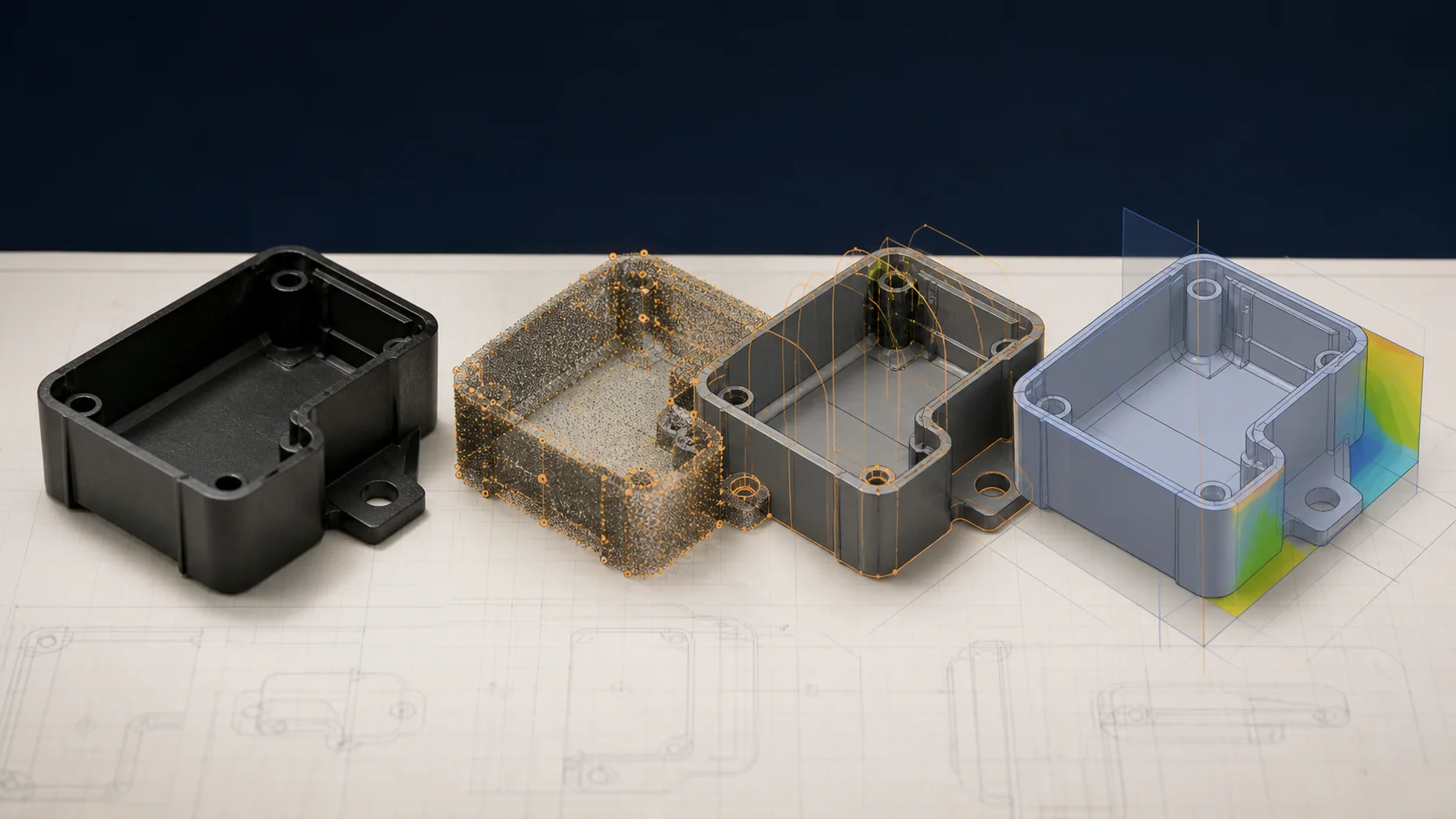
What matters most
- Identify the hot spot, dimensional drift, cycle constraint, or temperature imbalance using measured or simulated evidence.
- Review channel path, wall distance, diameter, pressure loss, supports, sealing, and additive-manufacturing limits.
- Plan material, heat treatment, corrosion control, cleaning, leak testing, and repair strategy.
Use conformal cooling for a defined thermal problem
Evaluate the technical choice together with part requirements, tooling consequences, production controls, and the evidence required for approval.
Problem
Identify the hot spot, dimensional drift, cycle constraint, or temperature imbalance using measured or simulated evidence.
Design
Review channel path, wall distance, diameter, pressure loss, supports, sealing, and additive-manufacturing limits.
Durability
Plan material, heat treatment, corrosion control, cleaning, leak testing, and repair strategy.
Economics
Compare added tool cost and maintenance with expected demand and verified production benefit.
Technical guide
The sections below retain the detailed design, tooling, process, and quality context needed to evaluate this topic beyond the summary.
Key Takeaways
- 1 The cooling phase accounts for 60–80% of total injection molding cycle time — making cooling channel geometry the single highest-leverage variable in throughput and part quality.
- 2 Conformal cooling reduces cycle time 10–40% vs. conventional channels; BCC lattice-augmented geometries have reached up to 63% in documented case studies.
- 3 Conformal inserts are produced by Direct Metal Laser Sintering (DMLS) and add 10–35% to tooling cost — an investment that typically pays back within 100,000–200,000 parts at production volumes.
- 4 Engineering guidelines specify channel diameter 4–10 mm, center positioned 2–5 mm from the cavity surface, and channel-to-channel pitch at 3–4× the diameter.
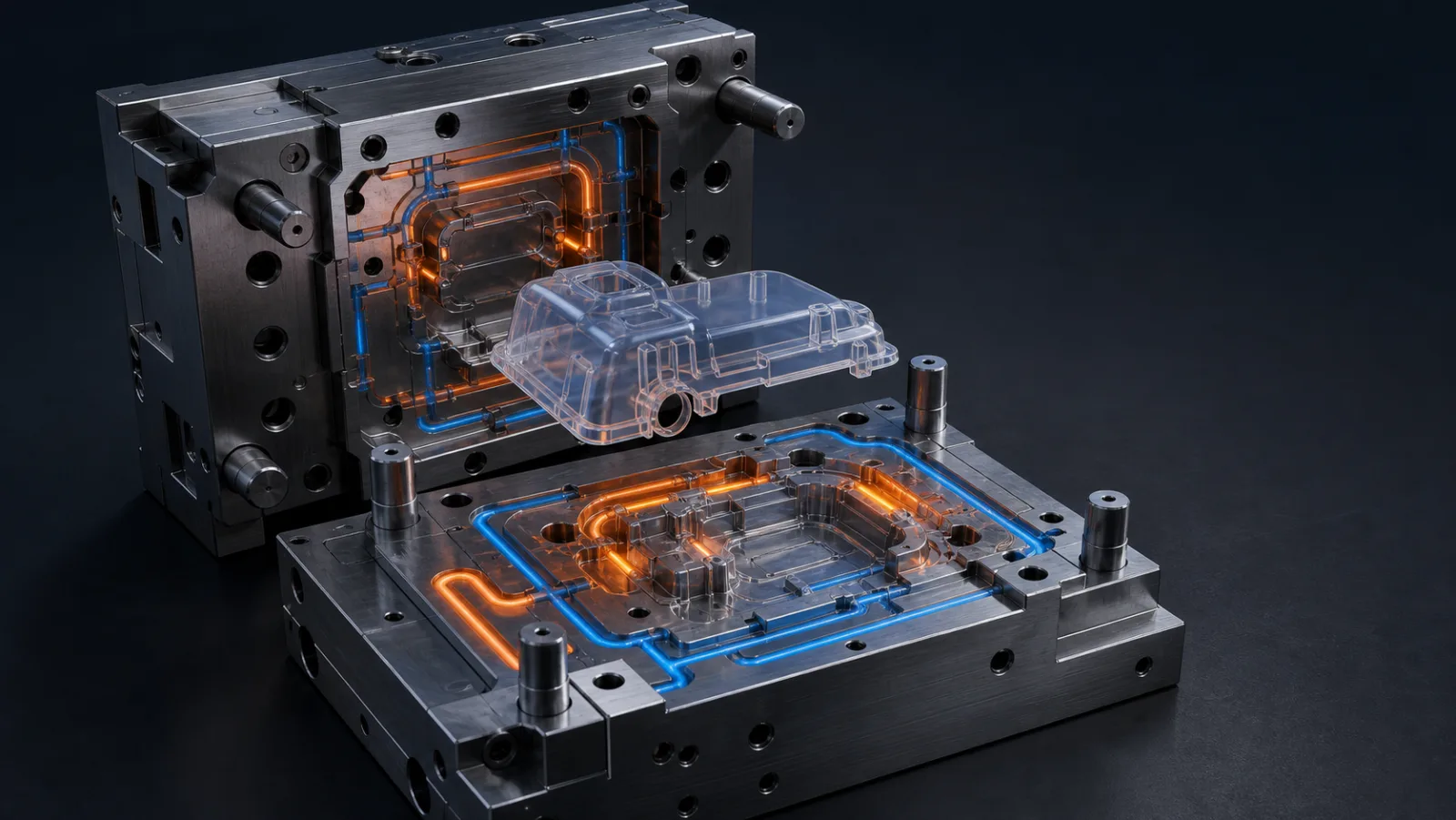
For most injection-molded parts, the bottleneck is not the fill — it is the cool. Once plastic enters the cavity, the press must wait for the part to solidify before ejection; how fast that happens depends almost entirely on how well heat is extracted through the mold steel. Conventional straight-drilled cooling channels, the industry standard since the 1950s, run in simple straight lines that cannot follow curved geometry, leaving cores, ribs, and deep-draw features chronically under-cooled. Conformal cooling channels solve this by following the three-dimensional contour of the part surface, holding a consistent 2–5 mm distance from every point on the cavity wall regardless of geometry. The result is faster, more uniform cooling — and a measurable reduction in cycle time, scrap rate, and dimensional variation.
Why Conventional Cooling Limits Complex-Geometry Parts
Straight-drilled cooling channels are limited by physics: a drill bit travels in a straight line, so channels run parallel to the mold parting surface and cannot reach curved walls, deep ribs, or cylindrical cores without leaving large un-cooled volumes. Where the channel cannot reach, steel acts as the only heat path — a slow one. The result is localized hot spots that force the process engineer to set a longer cooling time to ensure the slowest-cooling zone reaches ejection temperature. That conservative setting inflates cycle time for the entire shot, not just the problem area.
According to PTI.Tech’s 2025 industry analysis, the cooling phase represents 60–80% of the total injection molding cycle. This concentration means even a modest 20% improvement in cooling efficiency delivers a 12–16% reduction in total cycle time — one of the largest productivity gains available to a molder without changing the press, material, or part design.
Non-uniform cooling creates a second problem beyond cycle time: differential shrinkage. When one zone of a part cools faster than an adjacent zone, the plastic solidifies at different rates, generating internal stresses that produce warpage, sink marks, and dimensional variation outside tolerance. Uniform cooling is therefore a quality issue as much as a throughput issue, and it explains why conformal cooling is increasingly specified on automotive structural components, optical lenses, and medical housings where dimensional stability is a design requirement.
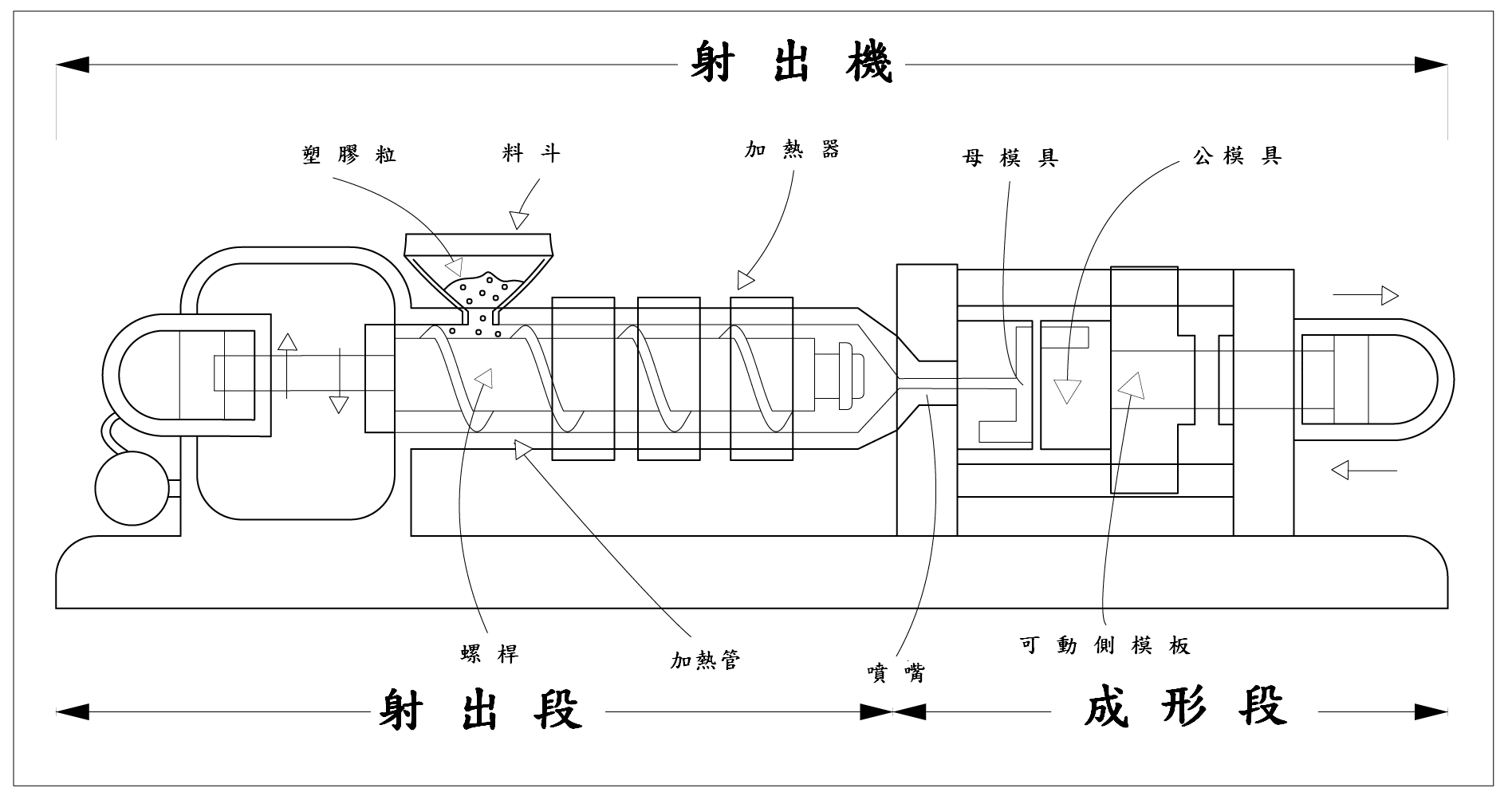
Conformal vs. Conventional vs. Hybrid Cooling: Performance Comparison
Three cooling architectures are used in production injection molds today. The choice between them is a function of part geometry, annual volume, and the cost premium that the program can support:
| Cooling Type | Channel Path | Cycle Time vs. Conventional | Tooling Cost Premium | Best For |
|---|---|---|---|---|
| Straight-Drilled (Conventional) | Straight lines, parallel to parting surface | Baseline | Baseline | Simple flat or symmetrical geometry; price-sensitive or low-volume programs |
| Hybrid Cooling | Conventional channels + conformal inserts at hot spots only | 10–20% reduction | 5–15% premium | Moderate complexity; targeted hot-spot elimination; mid-volume programs |
| Full Conformal Cooling | 3D DMLS channels following full cavity contour | 20–63% reduction | 10–35% premium | Complex geometry; high-volume (>500,000 shots/year); tight tolerances |
Real-world data confirms these ranges. PatSnap’s patent landscape analysis documents conformal cooling innovations cutting mold cycles 30–63% across automotive, optical, and high-cavitation mold applications. In a published Fictiv production case study, conformal inserts reduced total cycle time from 40 seconds to 16 seconds — a 60% reduction that reclaimed enough press capacity to defer a capital equipment purchase. A separate manufacturing study documented in SSRN research recorded scrap rate reductions of up to 30% alongside cycle time improvements when conformal cooling was introduced.
Channel Design Rules: What the Engineering Standards Specify
Conformal cooling channel design is governed by a set of interrelated geometric parameters. These balance heat transfer efficiency against the structural integrity of the mold insert, which must withstand injection pressures of 700–1,400 bar cycle after cycle. Getting the geometry wrong — channels too close to the cavity surface, or pitched too tightly — leads to insert deformation under clamp load, a failure mode that is both expensive and difficult to diagnose.
| Parameter | Engineering Guideline | Rationale |
|---|---|---|
| Channel diameter (d) | 4–10 mm | Ensures adequate flow rate and cleanability; below 4 mm risks scaling blockage in hard water over tool life |
| Distance from cavity surface | 2–5 mm (optimum 1.5×d) | Closer than 2 mm risks thermal erosion of cavity steel; beyond 5 mm reduces heat extraction efficiency |
| Channel-to-channel pitch | 3–4× channel diameter | Maintains structural steel wall between channels; prevents deformation under clamp load |
| Flow rate per circuit | 5–15 l/min | Turbulent flow (Re > 4,000) required for convective heat transfer; laminar flow removes heat 3–5× less efficiently |
| Pressure drop per circuit | ≤2–3 bar | Limits temperature control unit sizing; higher drops require oversized pumps and larger TCUs |
| Temperature uniformity target | <3°C variation across cavity | Differential beyond 3°C produces visible sink or warp on engineering plastics; ±0.2°C stability critical for part repeatability |
These parameters are drawn from TEDE Solutions’ 2025 design guidance and peer-reviewed MDPI Polymers research on conformal channel geometry optimization. The critical insight is that turbulent coolant flow — not channel proximity alone — drives the majority of heat transfer. A channel at 5 mm with fully turbulent flow will outperform a channel at 2 mm operating in the laminar regime. This is why flow rate is specified as a process parameter, not an afterthought of the temperature control unit setup.
The practical implication for procurement engineers: when reviewing a conformal cooling proposal from a mold supplier, ask for the CFD or Moldex3D simulation output that shows temperature uniformity across the cavity at the specified flow rate. A simulation that shows a >5°C differential after “conformal” channels have been added is a sign that the channel path has been compromised to avoid ejector pin positions or other tooling features, and the thermal benefit has been partially sacrificed.
ROI Model: When Conformal Cooling Pays Off
Whether conformal cooling is the right investment depends on three variables: annual volume, part cycle time, and the per-hour cost of press time. The following model uses conservative assumptions consistent with industry cost benchmarks and 2025 cost analysis data. It assumes a tooling premium of USD 8,000–15,000 for a mid-size conformal insert set, and a press operating cost of USD 60/hr (a common blended rate for a 200–350-ton machine including amortization, labor, and utilities):
| Scenario | Annual Volume | Cycle Time Saved | Press Time Saved / Year | Tooling Premium Payback |
|---|---|---|---|---|
| Conservative (20% reduction) | 500,000 shots | 8 sec (40 → 32 sec) | ~1,110 hours | ~18 months at USD 60/hr press rate |
| Moderate (30% reduction) | 1,000,000 shots | 12 sec (40 → 28 sec) | ~3,330 hours | ~8 months at USD 60/hr press rate |
| Optimized (55% reduction) | 2,000,000 shots | 22 sec (40 → 18 sec) | ~12,200 hours | <3 months at USD 60/hr press rate |
The model shows why conformal cooling is almost always justified above 500,000 shots per year, and is essentially mandatory above 2 million. Below 100,000 shots annually, the tooling premium rarely recovers within a typical tool life. Hybrid cooling — conformal inserts only at documented hot spots — provides a cost-effective middle path for programs in the 100,000–500,000 range where full conformal tooling cannot be justified by volume alone.
Beyond cycle time savings, the ROI model should also credit quality improvements: a 2024 SSRN manufacturing study documented scrap rate reductions of 10–30% after conformal cooling was introduced to high-complexity automotive molds, driven primarily by the elimination of warpage rejects. On a program running 1 million shots per year at 2% baseline scrap and a part value of USD 0.50, even a 10-point scrap reduction saves USD 100,000 per year — often exceeding the tooling premium on its own.
Evaluate Conformal Cooling for Your Program
LongTeam’s mold engineering team reviews cooling architecture as part of every DFM analysis. If your part has deep draws, complex ribs, or a tight cycle time target, we can model the cooling delta and advise whether conformal inserts will recover their premium at your annual volume — before any steel is cut.
Request a Cooling AnalysisWhat to confirm before supplier review
Use the drawing, material specification, expected demand, application conditions, and acceptance requirements to turn a general process discussion into a program-specific review.
- Which region cannot be cooled adequately by conventional circuits?
- What simulation or production evidence supports the design?
- How will channels be inspected, cleaned, and repaired?
- Which measured result will justify the added investment?
Continue the engineering review
Use the related guides and capability pages to connect this topic to part geometry, tooling, molding, and qualification decisions.