What matters most
- Define the engineering or quality decision the tool supports before discussing the technology.
- Confirm the source, completeness, ownership, retention, and security of production or drawing data.
- Compare recommendations with approved engineering methods and production evidence.
Evaluate AI by the decision it improves
Evaluate the technical choice together with part requirements, tooling consequences, production controls, and the evidence required for approval.
Use case
Define the engineering or quality decision the tool supports before discussing the technology.
Data
Confirm the source, completeness, ownership, retention, and security of production or drawing data.
Validation
Compare recommendations with approved engineering methods and production evidence.
Accountability
Keep engineers responsible for release, change control, and customer communication.
Technical guide
The sections below retain the detailed design, tooling, process, and quality context needed to evaluate this topic beyond the summary.
AI can help an injection molding team organize information, compare documented options, or flag patterns for investigation. It does not remove the need to understand the drawing, resin, mold, machine, process window, inspection method, and customer requirements. The useful question for a buyer is therefore not “Does the supplier use AI?” but “What information goes in, what comes out, and who approves the decision?”
Key takeaways
- AI is most credible when it supports a bounded task with an inspectable input and output.
- Physics-based mold-flow simulation, rules-based checks, statistics, automation, and machine learning are different methods and should be named accurately.
- A tooling or quality decision still requires accountable engineering review.
- Performance percentages from another factory are not evidence of what a supplier will achieve on your program.
First, separate AI from the other digital tools
Manufacturing software is often described with one broad “AI” label. That hides important differences in what the tool can prove and how its output should be reviewed.
| Method | Typical injection-molding use | Required human check |
|---|---|---|
| Rules-based check | Flag minimum draft, wall-thickness variation, or an undercut | Confirm geometry, tooling direction, material, and functional intent |
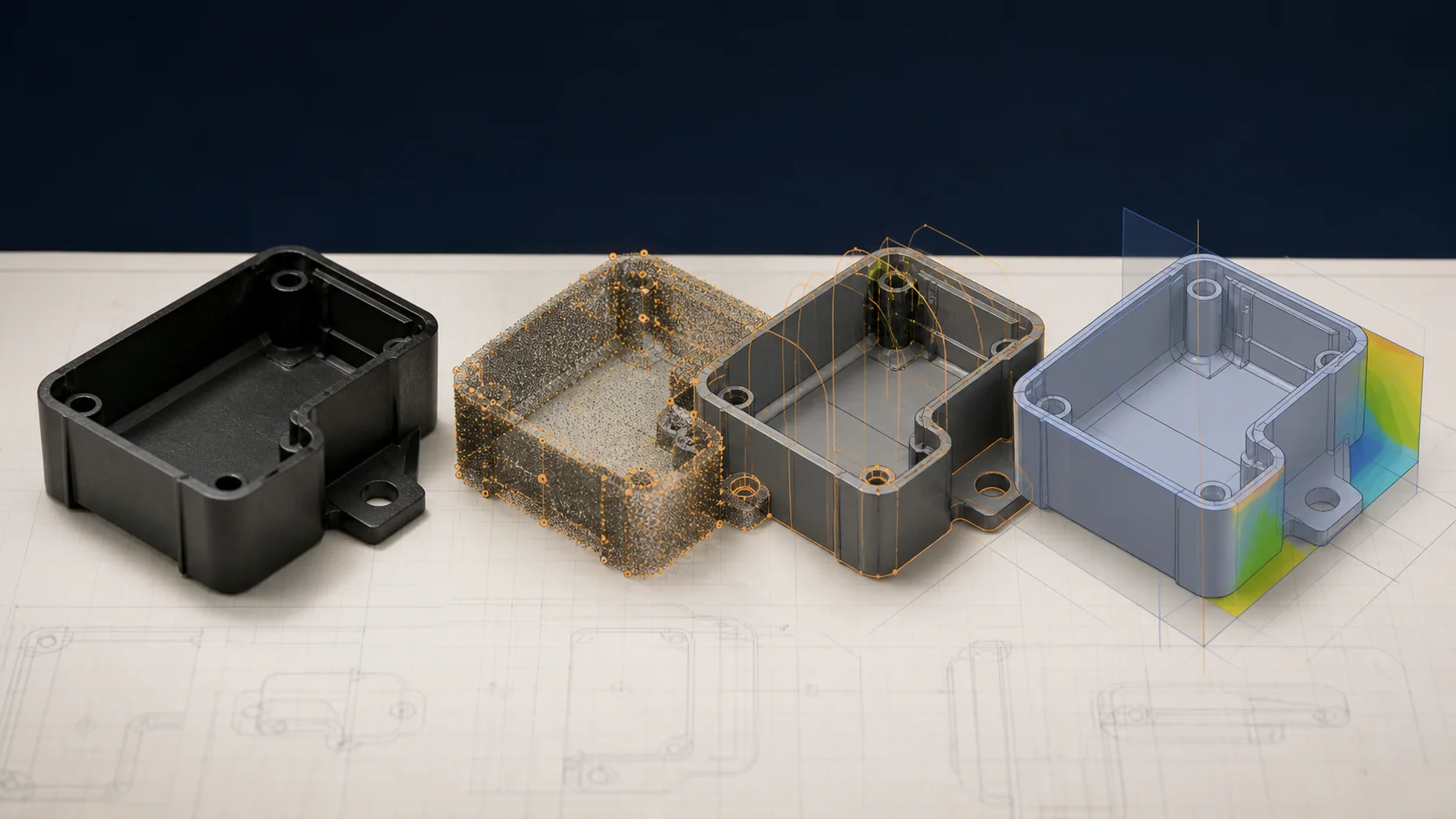
| Physics simulation | Model filling, packing, cooling, weld lines, or warpage | Validate inputs, assumptions, mesh, material model, and design implication |
| Statistical analysis | Find a trend or correlation in process or inspection records | Determine whether the relationship is causal and relevant to disposition |
| Machine learning | Estimate price, classify an image, or predict an outcome from trained examples | Check data coverage, error rate, generalization, and deployment conditions |
| Generative AI | Summarize, compare, translate, or organize documented information | Verify every technical statement against the controlled source |
Autodesk describes Moldflow as simulation software for filling, packing, cooling, warpage, material selection, and process optimization. Simulation may be part of a data-assisted workflow, but it should not be relabeled as AI unless a distinct AI or machine-learning component is actually used.
Where AI can assist an injection molding workflow
Early DFM triage
Automated CAD checks can surface potential draft, wall-thickness, undercut, and parting-line concerns before formal tooling review. Fictiv’s first-party description makes the boundary visible: automated feedback comes first, followed by a formal expert-generated DFM. That handoff matters because software cannot infer every sealing surface, cosmetic requirement, assembly load, or program tradeoff from geometry alone.
Quoting and information organization
AI and computational geometry can help classify features, compare prior records, or organize inputs for quotation. Xometry distinguishes machine-learning pricing and supplier matching from computational-geometry DFM. That precise vocabulary is more useful than calling the entire workflow AI-powered.
Quality prediction, when the measurement chain exists
A quality-prediction claim requires defined sensors, synchronized data, a trained model, validation against measured parts, and a documented response. Kistler’s example identifies cavity-pressure and temperature sensors, model analysis, predicted characteristics, and recorded results. Without a comparable chain, a supplier should describe its actual inspection and process-control method instead of borrowing an AI outcome.
What AI cannot decide by itself
- Whether a flagged geometry issue matters to the part’s real function or cosmetic specification.
- Whether a simulation is trustworthy when resin data, boundary conditions, or process assumptions are incomplete.
- Whether a statistical pattern is the root cause of a defect.
- Whether a predicted adjustment remains inside the approved process window and customer change controls.
- Whether a recommendation satisfies regulatory, safety, material-contact, or long-term reliability requirements.
The NIST AI Risk Management Framework calls for documented testing, evaluation, verification, validation, contextual interpretation, and limits under deployment-like conditions. In manufacturing terms: a model output is evidence to review, not automatic approval to change a mold or release a part.
LongTeam’s current, bounded use of AI
Workflow status: in use for internal information support.
LongTeam uses AI-assisted tools to organize internal ERP, program, and business information. LongTeam engineers remain responsible for manufacturing, mold design, tooling, process, and quality decisions.
This page does not claim that customer drawings are submitted to AI, that AI controls LongTeam molding machines, that process parameters adjust autonomously, or that AI predicts the quality of LongTeam production parts.
LongTeam operates an IATF 16949-certified automotive quality-management system. The certification and the bounded internal use of AI are separate facts: IATF 16949 establishes quality-system requirements; it does not itself verify an AI capability. The current certificate and site scope are available during supplier qualification.
Five questions to ask any supplier making an AI claim
- What goes in? Identify the drawing, CAD model, simulation result, inspection record, or production signal.
- What method is used? Separate rules, simulation, statistics, machine learning, and generative AI.
- What comes out? Ask whether the output is a flag, summary, comparison, prediction, or recommendation.
- Who approves the action? Name the engineering or quality role accountable for the decision.
- What are the limits? Require the applicable parts, materials, machines, data range, validation date, and non-guarantees.
Request an Engineering DFM and Tooling Review
Review LongTeam’s mold design and tooling capability, then send the drawing, material requirements, expected volume, cosmetic needs, and critical dimensions. A LongTeam engineer will review the program requirements and identify the DFM and tooling questions that should be resolved before steel is cut.
Request a DFM and Tooling Review →What to confirm before supplier review
Use the drawing, material specification, expected demand, application conditions, and acceptance requirements to turn a general process discussion into a program-specific review.
- What decision does the system support?
- Which data enters the system and who can access it?
- How is output checked against production evidence?
- Who approves actions and retains the decision record?
Continue the engineering review
Use the related guides and capability pages to connect this topic to part geometry, tooling, molding, and qualification decisions.